
Otto Barenberg is a student at Harvard Law School and the former Digital Director of OnLabor.
In November 2024, the Biden NLRB disarmed employers of the “most important weapon” in their anti-union arsenals: the captive audience meeting. Held in the workplace during paid work hours, captive audience meetings are “captive” because employers require attendance — and acquiescence — at pain of discipline or discharge. Until last year, if an employee refused to attend a meeting, tried to leave, expressed disagreement with management’s views, or even dared to ask a question, federal labor law entitled their employer to take disciplinary action, up to and including firing. It’s why 85 percent of anti-union campaigns used the captive audience tactic.
It’s no surprise, then, that the NLRB’s ban on captive audience meetings generated substantial opprobrium from the business community, a high-stakes lawsuit, and quick action by the NLRB’s new Acting General Counsel (who rescinded a Biden-era memo arguing for the ban). In turn, these actions catalyzed state bans, designed to backstop the NLRB’s anticipated about-face. Those state bans have faced court challenges, too.
At the heart of those legal challenges are employers’ free speech rights. Much turns on whether bans target employers’ conduct (i.e., the discipline and firings employers impose on workers who don’t participate in captive audience meetings) or employers’ speech (i.e., what employers tell employees in those meetings). If the bans just regulate conduct, they’re permissible. If they regulate speech too, they violate the First Amendment, absent a compelling government interest.
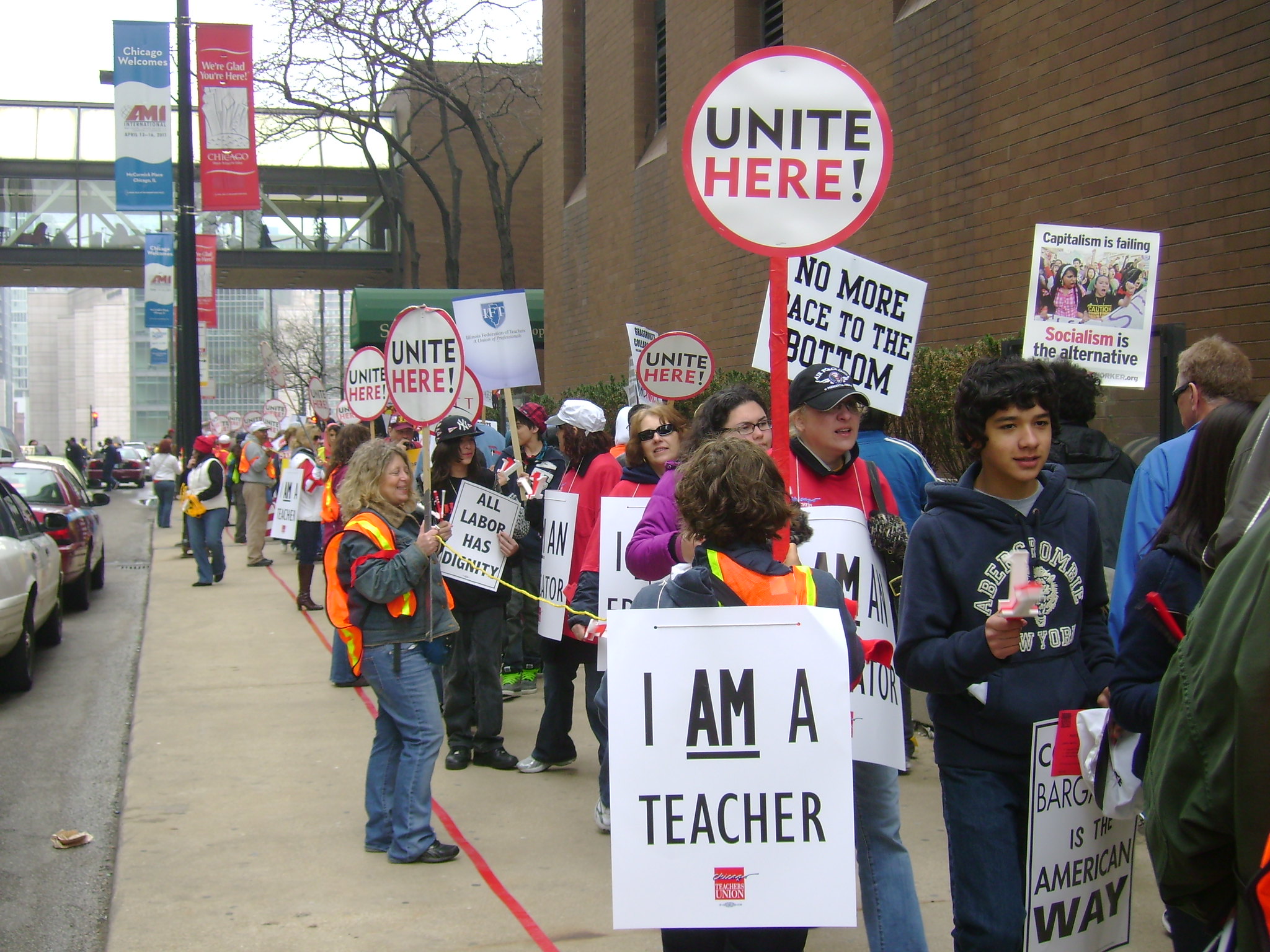
But as courts and litigants grapple with the speech-iness and conduct-ness of captive audience meetings, their analyses have largely overlooked parallels to another speech-versus-conduct issue on which courts have spoken at length: pickets. Captive audience meetings entail an element of employer speech and an element of economically coercive conduct; pickets likewise entail an element of employee speech and an element of economically coercive conduct, or so courts have said.
Pickets and captive audience meetings are, as a legal-doctrinal matter, two sides of the same First Amendment coin. If the government can restrict secondary pickets (as the Taft-Hartley Act does), it should likewise be able to restrict captive audience meetings. And if courts decide bans on captive audience meetings infringe on employers’ First Amendment rights, then bans on pickets infringe on employees’ First Amendment rights, too.
The Picket: From Speech to Coercion
To reveal the parallels, it’s worth tracing the development of the law on picketing. Until the New Deal, picketers were subject to criminal conspiracy laws, readily available state court injunctions, and expansive enforcement of vagrancy laws. Then came the National Labor Relations Act of 1935, which protected “concerted activities for . . . mutual aid or protection,” and a Supreme Court willing to give teeth to labor rights. In the seminal New-Deal-era case Thornhill v. Alabama (1940), the Court held that disseminating information about a labor dispute, in the form of a picket, is “freedom of speech . . . guaranteed by the Federal Constitution.” As Professor Catherine Fisk has noted: “When the Court first recognized labor protest as speech protected by the First Amendment, it perceived it to be part of a lively and fundamentally political debate about the equitable distribution of wealth and decent working conditions.”
Then, retrenchment. The Taft-Hartley Act of 1947 banned secondary pickets (alongside secondary boycotts). And across a series of decisions from the mid-1940s through the 1950s, the Court pulled back from Thornhill, asserting “picketing is more than speech.” In Giboney v. Empire Storage & Ice Co. (1949), for instance, a union of ice peddlers peacefully picketed a wholesaler for selling ice to non-union peddlers. A Missouri court enjoined the picket, citing a violation of antitrust law. The Supreme Court agreed with Missouri, stating it was “clear that [the peddlers] were doing more than exercising a right of free speech or press. . . They were exercising their economic power . . . to compel [the wholesaler] to abide by union rather than state regulation of trade.”
The Supreme Court upheld similar injunctions in Building Service Union v. Gazzam (1950) and Local Union No. 10, United Association of Journeymen, Plumbers and Steamfitters, etc. v. Graham (1953). In International Brotherhood of Teamsters, Local 695 v. Vogt (1957), a union attempted to organize gravel pit workers. Failing to make headway, the union held up signs at the entrance to the gravel pit reading: “The men on this job are not 100% affiliated with the A.F.L.” (What could be more clearly speech?) Wisconsin courts enjoined the picket, and the Supreme Court affirmed.
As Professor Fisk argues, “[t]o the extent that the purpose of the First Amendment is to enable effective self-government by allowing people to express and to hear a range of ideas, picketing is core.” Activists of all other stripes have a protected First Amendment right to picket and boycott. But, because labor picketing “is more than speech,” the government can restrict it.
The Captive Audience Meeting: From Coercion to Speech
If pickets are proscribable coercion, then surely captive audience meetings, which entail direct reprisal against employees who refuse to listen, are proscribable too. Not so, said District Court Judge Daniel Calabretta, enjoining enforcement of California’s ban on captive audience meetings. Judge Calabretta conceded that “taking an adverse employment action is not expressive conduct,” but held nonetheless that SB 399, which outlaws captive audience meetings on unions, religion, and politics, “has the inevitable effect of being directed toward employers who choose to engage in core expressive activity — sharing their opinions on religious and political matters.”
In other words, SB 399 restricts speech because it isn’t content neutral; to determine whether the statute prohibits an adverse employment action in a particular case, a decisionmaker must first determine whether the employer’s communication was related to politics or religion (not allowed) or something else (allowed). For instance, an employer can discipline an employee for missing a mandatory meeting on charitable donations, but cannot discipline an employee for missing a mandatory meeting on a minimum wage bill. According to Judge Calabretta, that distinction constitutes a content-based restriction on employer speech.
Content-based restrictions are “presumptively invalid unless they are shown to be narrowly tailored to serve compelling state interests.” The court “d[id] not find the desire to protect captive audiences in the employment context to constitute a compelling interest” — a contestable conclusion, no doubt. Nor did the court find SB 399’s applicability to “any communications” with an employer to be narrowly tailored to protect captive audiences.
But either Judge Calabretta’s logic or the proscriptions on pickets have to budge.
Granting for the sake of argument that pickets are “more than speech,” decisionmakers must still make two content-based determinations. First: is the protest at issue a labor picket or a political demonstration? Are the protestors saying: “Raise the state’s minimum wage!” or “Raise Walmart’s minimum wage!”? If the latter, a decisionmaker may then need to ask whether the picket is primary or secondary — i.e., whether the picketers are saying “our employer must raise wages” or “their employer must raise wages.” As with captive audience meetings, determining the speech content of a picket is a necessary precondition to determining whether the picket is proscribable. That’s a content-based restriction on employee speech, and strict scrutiny should apply.
Courts can’t have it both ways: if captive audience meetings can’t be outlawed, neither can secondary pickets.







Daily News & Commentary
Start your day with our roundup of the latest labor developments. See all
October 19
FDA reverses course on policy prohibiting off-duty union activity; FAA and NATCA reach deal to secure pay increase for air traffic controllers.
October 18
Federal judge again halts cancellation of the Bureau of Prisons’ CBA; tabletop gaming workers face roadblocks in union recognition.
October 16
Department of Labor reduces wage-and-hour enforcement at unionized workplaces; Fain's victory poses question of federal monitor's extension.
October 15
New reporting examines the rollback of child labor protections; California tries to block a strike; NLRB charges Wisconsin mental health provider with firing workers during union drive.
October 14
Eleventh Circuit overturns ERISA exhaustion rule; DHS finalizes removal of automatic renewal for work permits; AFGE challenges SSA over flexible scheduling policy.
October 13
Chicago hotel workers remain on strike; a coalition of Democratic states sues the Labor Department over canceled unemployment insurance grants; the Federal Labor Relations Authority establishes a new mediation framework for federal worker disputes.