
Amy L. Eisenstein is a student at Harvard Law School and a member of the Labor and Employment Lab.
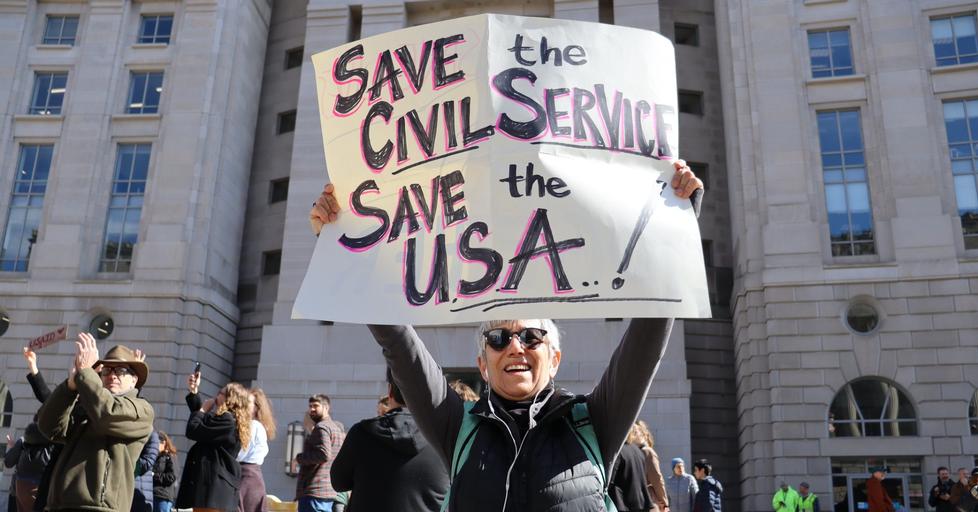
President Trump’s second term has been characterized by demands for intense political loyalty, value-laden executive orders, and attacks on the civil service. Consistent with this trend, the Administration in May issued a “Merit Hiring Plan” to federal agencies. It purports to construct “a Federal workforce dedicated to American values.” This post argues that the Plan may instead encourage job applicants to pledge their loyalty to the Trump Administration. The post then builds upon prior arguments — some raised in recent union lawsuits — to suggest that the Plan raises serious questions under the First Amendment.
Background
Imagine you wish to apply for a wildland firefighter position in Whiteriver, Arizona. Your duties include fire suppression, monitoring weather data and fire activity, and loading personnel and equipment on helicopters. Your pay scale is $52,431 to $68,155.
Because of the Merit Hiring Plan, you are encouraged to answer the following questions:
- How has your commitment to the Constitution and the founding principles of the United States inspired you to pursue this role…? Provide a concrete example…
- [H]ow would you use your skills and experience to improve government efficiency and effectiveness? Provide specific examples where you improved processes, reduced costs, or improved outcomes.
- How would you help advance the President’s Executive Orders and policy priorities in this role? Identify one or two relevant Executive Orders or policy initiatives that are significant to you, and explain how you would implement them if hired.
- How has a strong work ethic contributed to your professional, academic or personal achievements?
“While your responses are not required and will not be scored,” you are encouraged “to thoughtfully address each question.” The same is true for applicants to become a government meteorologist, nuclear materials courier, executive assistant, or bridge engineer.
For each of these jobs, there is no logical connection between the questions asked and the qualities that make a person an effective employee. This raises the suspicion that the federal government is actually screening for political loyalty, which the First Amendment forbids.
First Amendment
In Elrod v. Burns (1976), the Supreme Court considered a case wherein “respondents were required to pledge their political allegiance to the Democratic Party” if they wanted to keep their jobs. The Court held that the plaintiffs stated a valid First Amendment claim. “The principal intrusion of patronage hiring on First Amendment interests,” the Court wrote, “arises from the coercion on [political] associational choices that may be created by one’s desire initially to obtain employment.”
The Court analyzed two government interests in Elrod, among others: efficiency and loyalty. President Trump articulated both reasons for the Merit Hiring Plan: Hiring “individuals committed to improving the efficiency of the Federal government” is the first goal. And, the Executive Order prompting the plan touted that it would “ensure that the Federal workforce is prepared to help achieve American greatness,” sounding in Trump’s partisan chant to Make America Great Again.
Yet, the Elrod Court shot down both aims — efficiency and loyalty — as too weak to overcome civilians’ First Amendment interests. The Court said it was unlikely that a “mere difference of political persuasion motivates poor performance.” Then the Court concluded that only those in policymaking positions could be assessed based on their loyalty to an administration.
In Branti v. Finkel (1980), the Court clarified that the correct inquiry is whether “party affiliation is an appropriate requirement for the effective performance of the public office involved.” The Court reasoned, “no one could seriously claim that Republicans make better [state university football] coaches than Democrats…”
Finally, in Rutan v. Republican Party of Illinois (1990), the Court held that, just like patronage firing in cases like Elrod and Branti, patronage hiring violates the First Amendment. The Governor of Illinois could not legally review whether an applicant voted for Republicans when making exceptions to a hiring freeze.
Granted, Governor Thompson’s patronage criteria were more explicit than President Trump’s. The Governor’s office reviewed applicants’ voting and political contribution histories, whereas the Trump Administration asks voluntary questions that may seem innocuous in isolation. However, when read together, these questions may still “condition[] hiring decisions on political belief and association[, which] plainly constitutes an unconstitutional condition, unless the government has a vital interest in doing so.”
The Questions
The questions the government asks of applicants — all those applying to positions graded GS-05 or higher, with a few exceptions — seem crafted to avoid litigation. After a public employee association urged the acting U.S. Special Counsel to challenge the questions, the Administration emphasized that answering them is optional. Thus, the Administration would argue, they do not “require” an Elrod-like pledge of political allegiance.
In practice, the questions may not even be optional. OPM encourages agencies to evaluate applicants’ answers as they would evaluate a cover letter. Most applicants would hardly forgo writing a cover letter, assuming they want the job.
Even if applicants’ answers are entirely voluntary, this does not necessarily render the questions lawful. For example, in the labor law context, the Eighth Circuit affirmed enforcement of an NLRB order that an employer cease “[r]equesting or requiring prospective employees…to answer [employment application] questions…as to their willingness…to cross a picket line in the event of a strike.” Furthermore, in the ADA context, an employer may not ask a job applicant to voluntarily disclose whether they have a disability and then use that information in making a hiring decision, even if answering the question is optional. Thus, assuming the Merit Hiring Plan’s questions are optional, they may still violate the law.
Admittedly, the questions do not connote as explicit a requirement of political loyalty as did the criteria invalidated by the Court in cases like Rutan. When read in isolation, asking an applicant to expound on his work ethic seems totally unrelated to political allegiance.
Yet applicants will most likely read all the questions before answering any of them. When analyzed as a whole, the questions arguably screen for political loyalty, a familiar priority for this administration.
Question #3 is most obviously political. It asks an applicant to identify Executive Orders that the applicant finds “significant” and would like to “help advance.” Meanwhile, Trump’s EOs have projected the extreme policy priorities of Project 2025, with which most Americans disagree.
Question #2 hints at Trump’s politically controversial Department of Government Efficiency, and could be read as an opportunity for applicants to expound on how they would contribute to Trump’s attempt to “cut the fat” in government.
Question #1 references commitment to the founding principles, which have become somewhat synonymous with American conservatism. The founding principles are promoted in conservative arguments by the same organization that conceived of Project 2025.
Question #4 may very well be innocuous, or it could be read as a way for an applicant to justify herself as distinct from a “DEI hire.”
In conclusion, applicants may be “coerced” by the Merit Hiring Plan to make “associational choices” to get their desired job, even if party affiliation has no relation to their career as a firefighter or a bridge engineer. Or they may open the application and decide not to apply at all because they can’t demonstrate their interest in the job without conveying a set of political commitments that are not their own.




Daily News & Commentary
Start your day with our roundup of the latest labor developments. See all
September 10
Amazon workers allege pregnancy discrimination; federal unions challenge USDA reorganization; NYC warns of silicosis risks.
September 9
Wynn Las Vegas employees allege anti-union retaliation; Amazon faces a class action over pregnancy accommodations; H-1B demand plunges following a six-figure visa fee.
September 8
In today’s News and Commentary, workers and unions across America celebrate Labor Day, California’s SEIU Local 1000 prepares for a strike authorization vote, and New York City creates the Office of Worker Power. On Monday, labor unions and workers gathered in cities across the United States in celebration of Labor Day. Parades and rallies took […]
September 7
Eighth Circuit finds DOL order violates Seventh Amendment; 1,300 workers at Encore Boston Harbor go on strike.
September 6
Encore casino workers strike; President Trump commutes sentence of former Philadelphia IBEW leader; Durham labor activist ends his hunger strike against Amazon.
September 4
NLRB advice memo narrows political protest protections; NLRB asks federal appeals court for deference.