
In today’s News and Commentary, Iowa joins a growing list of states that are relaxing child labor laws, Los Angeles union workers join the Writers Guild of America strikers in a show of solidarity, and Alaska’s Supreme Court rules that an executive order requiring employees to opt in to union membership was illegal.
Iowa Governor Kim Reynolds signed Senate File 542 in to law on Friday, allowing teen workers to work longer hours and in jobs that were once prohibited. Twenty states have rolled back their child labor laws in response to labor shortages. In April, Iowa reported an unemployment rate of 2.7%. S.F. 542 will allow 16- and 17-year-olds to serve alcohol, increases from four to six the number of hours children as young as 14 can work during the school year, and permits teenagers to work in formerly prohibited jobs as long as they participate in a work-based learning program. Governor Reynolds says that the law “instill[s] values in the next generation and provide[s] opportunities for young adults to earn and save.” Democrats in the Iowa House succeeded in ensuring that the bill would continue to prohibit teenagers from working in the most dangerous of industries, such as mining and meat packing.
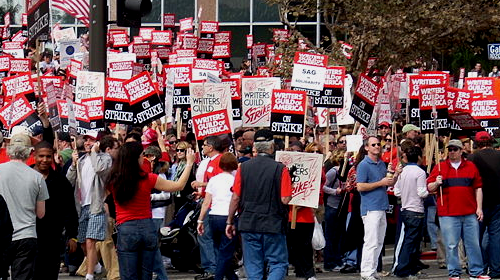
As the Writers Guild of America closed out its fourth week of striking, the strikers were joined by Los Angeles-area unions from across several different industries. Teachers, tourism and hospitality workers, and public employees joined the picket line in a show of solidarity. These unions represent over 200,000 workers, many with contracts expiring in 2023 as well. The WGA is striking against the Alliance of Motion Picture and Television Producers who have yet to agree to bargain.
In 2019, Alaska Governor Mike Dunleavy issued an executive order requiring state employees to annually opt in to union membership, curtailing their union’s ability to automatically collect union dues from the paychecks of its members. On Friday, May 26, Alaska’s Supreme Court upheld a lower court ruling that the Dunleavy administration had acted illegally in changing the union dues rules. The administration relied on the 2018 U.S. Supreme Court decision, Janus v. State, holding that government employees cannot be forced to contribute to labor unions representing them in collective bargaining. The Alaska State Employees Association argued that the Janus holding applied only to non-union workers required to pay fees to the union. The court awarded the union $450,000 in damages, legal fees and interest.


Daily News & Commentary
Start your day with our roundup of the latest labor developments. See all
October 6
Protect College Sports Act dampens athlete unionization outlook; Stanford RA union decides to withdraw petition
October 5
Delaware bans captive audience meetings; EEOC settles remote work national origin discrimination claim; First Circuit stays enforcement order in VA's dispute with AFGE.
October 4
Boston nurses announce open-ended strike; federal judge restores federal prison workers' union protections; St. Louis workers form the first movie theater union in Missouri.
October 2
Gov. Newsom signs bill regulating AI in workplace; federal judge blocks Trump's $100,000 H-1B visa fee.
October 1
Senate confirms Keith Sonderling as Labor Secretary; Amazon warehouse workers launch an unfair labor practice strike.
September 30
Harvard grad union wins in First Circuit; AI data trainers initiate misclassification suits; Trader Joe’s found liable under ERISA.