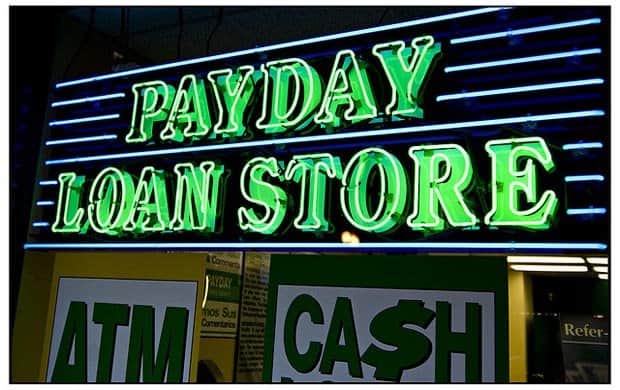

The Boston Globe reports on the growth of wage-advance companies that allow workers to access money they have already earned but not yet received, often through an app. Workers can connect the app to their bank accounts or their employers’ payroll systems. The wage-advance company then fronts the workers a portion of their wages, which it recovers, on payday, either from the workers’ bank accounts or directly from the workers’ employers. The wage-advance companies generally charge a subscription rate or a fee for each transaction. Proponents of the wage-advance companies argue that they allow workers to avoid high-interest payday loans while still accessing the funds they need to live and work. However, the fees charged by wage-advance companies, when calculated as an annual percentage rate, are often as high or higher than the interest rates charged by traditional payday lenders. “Ultimately, this is just another way to monetize poverty,” says Gillian Mason, co-executive director of the worker advocacy nonprofit Massachusetts Jobs With Justice. “It gives the illusion that employers are doing something about this problem.”
A new report on California’s Private Attorney General Act (PAGA) highlights the law’s role in improving working conditions and increasing employer compliance with California’s labor code. PAGA, passed in 2004, allows workers to sue their employers in the name of the state for wage and labor violations. While employer associations have attacked the law as a “job killer,” the UCLA Labor Center, the Center for Popular Democracy, and the Partnership for Working Families report that the law has allowed California employees to recover millions of dollars in stolen wages. In addition to unpaid wages, the law also requires employers to pay civil penalties for labor code violations. Workers who sue to enforce the labor code receive 25% of the penalty, and the California Labor and Workforce Development Agency (LDWA) receives the rest. In 2019 alone, the LDWA collected over $88 million in civil penalties. All of the money, under PAGA, must be used to fund labor code enforcement and educational initiatives on workers’ rights. The report points out that PAGA presents a useful strategy for undermining mandatory arbitration clauses: under California law, an employee covered by a mandatory arbitration clause may still sue their employer in the name of the state, since the state is not a party to the private arbitration contract.
Harvard and its Graduate Student Union have agreed on three tentative contract provisions after their latest federally-mediated bargaining session, on February 6. In an email to its members, the HGSU-UAW announced that the provisions would provide student workers with guaranteed federal holidays and winter recess, access to the employee assistance program—which provides financial counseling and mental health and crisis care—and discounts on MBTA passes and access to biking and parking benefits. Harvard and the HGSU-UAW have yet to agree on provisions regarding workload protections, union dues, discrimination and harassment, and compensation.
While the national union membership rate continues to fall, new data from the Bureau of Labor Statistics (BLS) show a significant increase in the number of Americans participating in strikes and work stoppages. According to an analysis by the Economic Policy Institute (EPI), 2019 marked “the greatest number of work stoppages involving 20,000 or more workers since at least 1993, when the BLS stated providing data that made it possible to track work stoppages by size.” The EPI attributes the increase in strike activity to the low unemployment rate, which may provide workers with some assurance that they could get new jobs should they be fired for striking, and the lack of wage growth, particularly for low-wage workers.





Daily News & Commentary
Start your day with our roundup of the latest labor developments. See all
September 29
Unions, AI companies, and private equity firms form a new coalition to shape data center policies; unions express support for the Paramount-Warner Bros. merger.
September 28
The Protect College Sports Act nears passage in the Senate; San Francisco municipal workers agree to contract extensions.
September 27
The Trump Administration reaches a settlement with federal unions on reduction in force actions; the United Auto Workers file an en banc petition seeking review of a Second Circuit decision regarding labor arbitrations.
September 25
Healthcare workers rally to restore legal status for TPS holders; nurses at a Maine hospital overwhelmingly vote to form their union despite alleged aggressive union busting tactics.
September 24
NLRB abandons rule for offensive conduct during protected activity; New York home care workers seek a union election; maritime deck officers endure long fight for first contracts.
September 23
DoorDash settles delivery-worker pay claims; Philadelphia school workers win new contract; stock gains spur retirements.