

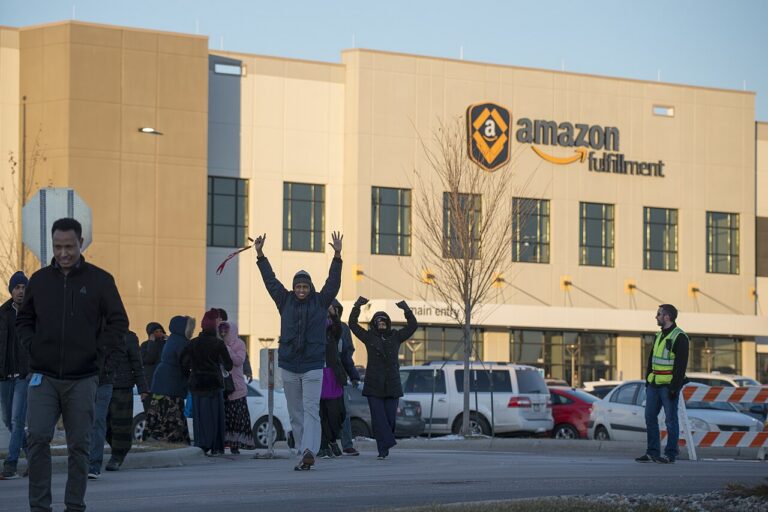
The Huffington Post published a long-form article on Amazon’s use of temp workers at its shipping facilities. The piece detailed the on-the-job death of a temp worker employed by a placement agency struggling to earn a spot as a full-time Amazon employee. Among the practices called into question was the company’s policy of having workers notify on-staff medical workers before calling 911–a delay that might have dire consequences–as well as the highly competitive environment for temp workers who operated under physical strain of walking twelve miles each shift while picking up and moving boxes for shipment.
The Cleveland Plain Dealer reported on the Republican plan to roll back some of the Obama administration’s labor and employment reforms through government funding bills. The list of targeted reforms includes the NLRB’s Browning-Ferris decision, which provides an avenue to hold joint employers liable for their contractors’ labor violations, an OSHA rule limiting worker exposure to silica dust, and executive orders mandating that government contractors provide paid sick leave and pay workers at least $10.10 per hour. Despite this move, these measures are unlikely to become law since they would have to overcome a Democratic filibuster and potential veto..
An article in Politico highlighted criticism that Representative Paul Ryan’s demand for family in exchange for the House speakership stands in tension with his long opposition to paid parental leave. Judy Conti, federal advocacy coordinator at the National Employment Law Project, said, “Paul Ryan is rightly concerned about his job’s impact on his spouse and children, . . . Yet [he] isn’t willing to guarantee that all workers . . . have the necessary tools to balance their work and family obligations.” Ryan has supported legislation that would allow employers to substitute overtime pay for compensatory time, where employers could substitute paid time off for time-and-a-half payments. Ellen Bravo, an advocate for paid leave and executive director of Family Values @ Work criticized Ryan, saying, ““Paul Ryan is talking about family time for fun, which we all want . . . but the bare minimum is to have family time when a family member is in need.” Bravo also criticized the compensatory-time policy as an “illusion” of paid time off because it requires employees to spend more time away from their families through mandatory overtime before they can be compensated time off.
The Second Circuit affirmed an NLRB decision that held that an employee’s complaints about the workplace posted to social media could constitute protected action under Section 7 of the NLRA. In the case, a sports bar fired two employees for posting and “liking” comments on Facebook that criticized the bar’s tax withholding practices. Even if the bar’s customers saw the comments and obscenities contained in the post, the court reasoned that almost all social media posts “have at least some potential to be viewed by customers” and that strong language “accords with the reality of modern-day social media use.”


Daily News & Commentary
Start your day with our roundup of the latest labor developments. See all
July 3
Unions seek a preliminary injunction to prevent USDA downsizing; the D.C. District Court issues a preliminary injunction against new student loan regulations; Matt Bruenig releases an analysis of Starbucks’ ongoing legal battle against Starbucks Workers United.
July 2
First Circuit denies federal worker unions’ mandamus petition; federal court denies preliminary injunction against new union reporting rule; House introduces the Securing Agriculture’s Workforce Act.
July 1
Trump nominates Keith Sonderling as Labor Secretary; DOL eliminates disparate-impact liability from Title VI regulations; OPM finalizes rule allowing suitability-based removal of federal employees for post-appointment conduct.
June 30
SCOTUS ends removal protections for agencies; staff at NYC cocktail bar vote to unionize.
June 29
In today’s News and Commentary, student-athletes file a class action suit challenging the NCAA’s new Age-Based Rule, a federal judge declines to issue a preliminary injunction against FEMA’s reduction in force but expedites proceedings, and Gavin Newsom opposes California’s proposed billionaire tax in favor of a federal approach. On Thursday, DeJuan Campbell, at basketball player […]
June 28
Philadelphia utility workers announce July 4 strike; national parks workers vote to unionize; Michigan considers “right to disconnect” bill.