
Fred Messner is a student at Harvard Law School.
With job market data from the Fall coming into focus, it is becoming ever clearer that Striketober was accompanied by a period of unprecedented worker mobility. This “Great Escape” is the subject of an extended profile by David Dayen in this morning’s American Prospect. “Workers are quitting across the labor force,” Dayen reports. A record 4.43 million, a full 3% of the American workforce, left their jobs in September, with quits in some sectors reaching almost 7%. Through careful interviews with a diverse group of workers, Dayen traces the historical, material, and ideological forces driving the trend. The entire article is worth exploring as a welcome contrast to the often employer-centric coverage of the Biden labor market. On a similar note, the Wall Street Journal reported this weekend that “[s]ome restaurants, struggling with labor shortages and the return of customers to on-site dining, are choosing to scale back at times on often less-profitable delivery and to-go orders.” The labor implications of this shift remain to be seen, but, at the very least, it is yet another sign that emboldened workers are gaining leverage and affecting the day-to-day calculus of business owners.
Elsewhere in long-form labor journalism Jacobin’s fall issue reviews explores the state of pay-secrecy laws in the United States and abroad. These state laws, which ban employers from prohibiting workers from discussing their wages, have been shown to reduce the gender pay gap and boost wages across the board. In theory, these laws are unnecessary in light of Section 7 of the National Labor Relations Act, which the NLRB has interpreted to make unenforceable employers’ pay-secrecy rules. Nevertheless, the article explains, “[s]ome 60 percent of private-sector workers report that their employers have similar policies,” and efforts to end the practice remain hamstrung by the NLRB’s limited power to meaningfully penalize violators.
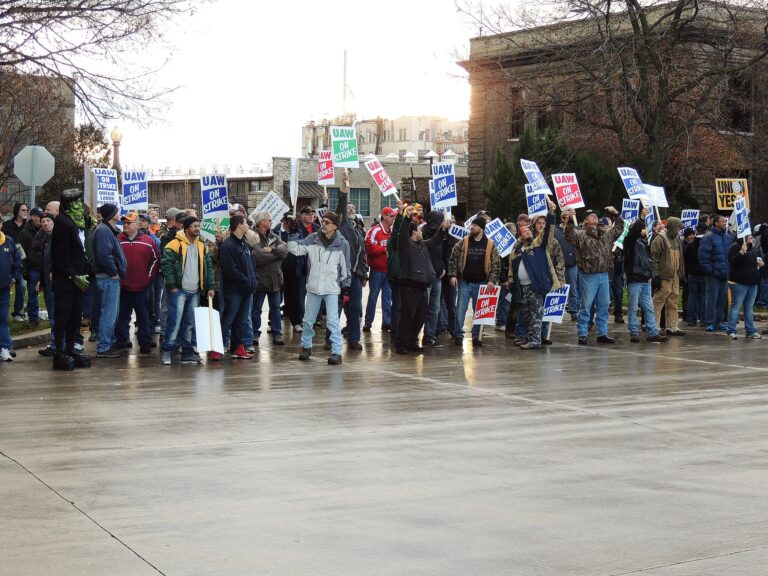
In less auspicious Striketober news, an Alabama judge extended an injunction against the United Mine Workers of America, which represents workers currently striking at Warrior Met Coal, Inc. While federal courts are largely barred from issuing injunctions against labor activity, state courts retain the authority to enjoin alleged violent conduct on picket lines. In this case, Judge James Roberts of Tuscaloosa County was persuaded by a video released by Warrior purporting to show picketers blocking and attacking cars; he was unconvinced by MWA’s insistence that “[a]ny time [its] members are involved in anything on the picket line, it’s retaliatory.” The injunction, which prohibits workers from gathering within 300 yards of Warrior Met installations, is at least the second one to issue from a state court this fall. In October, an Iowa state judge restricted striking John Deere workers to pickets of four or fewer individuals and banned them from bring chairs or using barrel fires to stay warm.
Finally, Jotwell’s Matt Bodie reviewed Abolish the Employer Prerogative, Unleash Work Law, a forthcoming new paper by Gali Racabi of Harvard Law School examining the “employer prerogative” in American corporate, employment, and labor law. Racabi, Bodie explains, “excavates” the persistent but rarely acknowledged—let alone interrogated—assumption in American law that “the employer’s designated representatives have ‘the legal authority to make unilateral decisions in the workplace.’” And employers have defended this prerogative, Racabi demonstrates, by wielding it to “dodge efforts to regulate the employment relationship by restructuring that relationship” and to “threaten to punish workers and the community by withdrawing or withholding the benefits generated by the firm’s business.” Emphasizing that the employer prerogative is not a fact of nature but rather one possible arrangement among many, Racabi proceeds to consider alternatives, concluding (as the article’s title might presage) that the way forward is to replace the prerogative with a more prosocial regime.




Daily News & Commentary
Start your day with our roundup of the latest labor developments. See all
March 29
The Department of Veterans Affairs re-terminates its collective bargaining agreement despite a preliminary injunction, and the Federal Labor Relations Authority announces new rules increasing the influence of political appointees over federal labor relations.
March 27
“Cesar Chavez Day” renamed “Farmworkers Day” in California after investigation finds Chavez engaged in rampant sexual abuse.
March 26
Supreme Court hears oral argument in an FAA case; NLRB rules that Cemex does not impose an enforceable deadline for requesting an election; DOL proposes raising wage standards for H-1B workers.
March 25
UPS rescinded its driver buyout program; California court dismissed a whistleblower retaliation suit against Meta; EEOC announced $15 million settlement to resolve vaccine-related religious discrimination case.
March 24
The WNBPA unanimously votes to ratify the league’s new CBA; NYU professors begin striking; and a district court judge denies the government’s motion to dismiss a case challenging the Trump administration’s mass revocation of international student visas.
March 23
MSPB finds immigration judges removal protections unconstitutional, ICE deployed to airports.