

The National Labor Relations Board is calling for amicus briefs on whether it should continue to exert jurisdiction over charter schools. In two decisions handed down in 2016, the Board held that charter schools, which are privately owned but publicly funded, were private corporations rather than public schools for the purposes of federal labor law. The Board reasoned that, unlike public schools, charter schools are not created by government entities and their governing boards are not accountable to public officials. Consequently, teachers and support staff seeking to unionize at charter schools must do so under the National Labor Relations Act instead of state laws that apply to public school teachers. Now, the Board is considering overturning that precedent. The case at issue—Kipp Academy Charter School—comes to the Board after a regional director granted a petition for a union decertification election. The union appealed, asserting that the NLRB lacks jurisdiction because the school is a “political subdivision of New York.” The jurisdiction issue will apparently turn on whether charter school-related labor disputes have a substantial enough effect on interstate commerce “to warrant the exercise of jurisdiction.” If the answer is no, the Board can decline to exert jurisdiction per Section 14(c)(1) of the Act. Briefs are due March 6.
Massachusetts is considering limiting the amount of money that labor unions can donate to political candidates, reports the Boston Globe. The state’s Office of Campaign Finance wants to lower the annual contribution limit from $15,000 per candidate to $1,000 per candidate, the same as the individual contribution limit. The draft regulations also cap contributions to a political action committee at $500 per year, and to a political party at $5,000 per year. Massachusetts already bans political contributions from corporations; last September the Supreme Judicial Court held that such a ban does not violate businesses’ First Amendment rights and may prevent political corruption.
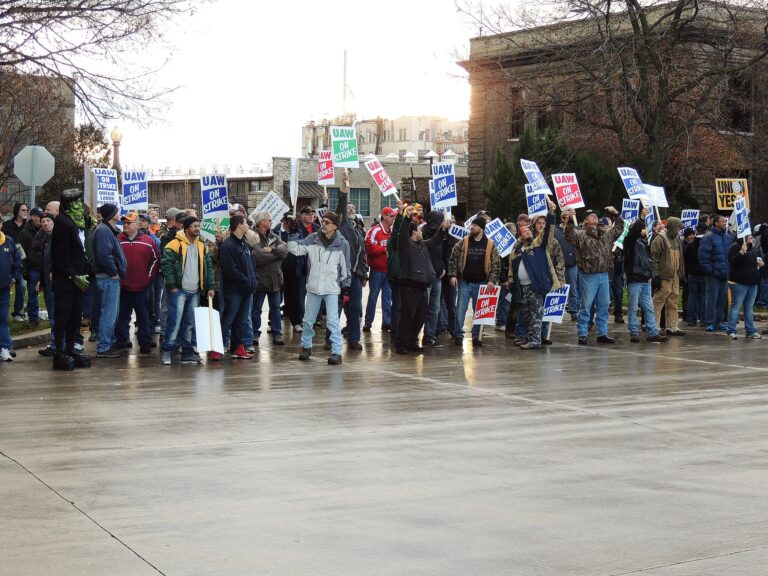
In Denver, a teachers’ strike is looking increasingly likely. On January 22, teachers represented by the Denver Classroom Teachers Association voted to authorized a strike for the first time in 25 years after months of failed negotiations with the school district. Denver Public Schools then appealed to the Colorado Department of Labor and Employment for mediation assistance in an effort to delay the strike (and evidently also threatened to retaliate against teachers on immigration visas). While the state has not yet officially intervened, Governor Jared Polis has asked the two sides to meet with him and review a budget analysis prepared by his office. The school district, which initially requested intervention, praised the governor’s efforts, but the union signaled its unwillingness to meet with state officials. All of this has led Colorado’s labor chief to accuse the parties of engaging in “political theater” and to opine that “[m]oving negotiations forward seems highly unlikely at this point ….” If the Department of Labor and Employment chooses to intervene, any strike will be delayed by as many as 180 days.
Finally, General Motors announced that it would add 1,000 workers to its plant in Flint, Michigan, with priority given to those whom it has previously laid off. GM has laid off some 15,000 workers over the past year as it has halted production at five of its North American factories. The company has been roundly criticized by labor unions and President Trump alike, with the latter at one point threatening to “eliminate subsidies” for the company. Most recently, Unifor, Canada’s largest private sector union, aired a Super Bowl commercial on Canadian networks criticizing GM for closing its Ottawa plant and “Leav[ing] Canadians Out in the Cold.”



Daily News & Commentary
Start your day with our roundup of the latest labor developments. See all
March 25
UPS rescinded its driver buyout program; California court dismissed a whistleblower retaliation suit against Meta; EEOC announced $15 million settlement to resolve vaccine-related religious discrimination case.
March 24
The WNBPA unanimously votes to ratify the league’s new CBA; NYU professors begin striking; and a district court judge denies the government’s motion to dismiss a case challenging the Trump administration’s mass revocation of international student visas.
March 23
MSPB finds immigration judges removal protections unconstitutional, ICE deployed to airports.
March 22
Resurgence in salting among young activists; Michigan nurses strike; states experiment with policies supporting workers experiencing menopause.
March 20
Appeal to 9th Cir. over law allowing suit for impersonating union reps; Mass. judge denies motion to arbitrate drivers' claims; furloughed workers return to factory building MBTA trains.
March 19
WNBA and WNBPA reach verbal tentative agreement, United Teachers Los Angeles announce April 14 strike date, and the California Gig Workers Union file complaint against Waymo.