

Zachary Boullt is a student at Harvard Law School.
A group of quality assurance testers and developers at Activision Blizzard studio Raven Software, responsible for Call of Duty: Warzone, have staged a walkout over terminated testers. This is the third recent worker action at Activision Blizzard. The demonstrating employees have demanded that all quality assurance testers, including those laid off, receive full-time position offers. So far 30% of the testers have had their contracts terminated, right after testers have engaged in five weeks of overtime. All of those terminated were in good standing with the company. The demonstrating employees protested that some of the employees terminated had relocated to Wisconsin without assistance from Activision Blizzard anticipating a return to in-person work. According to Ethan Gach of Kotaku, quality assurance testers are among the most exploited workers in game development.
Activision Blizzard is not the only company under fire for layoffs. Better.com, a fintech mortgage company that just received $750 million in financing to go public, announced over Zoom that it was laying off more than 900 employees before the holidays. While CEO Vishal Garg claimed the layoffs were for market efficiency and productivity reasons, Fortune has reported that Garg said the employees were stealing from colleagues and customers by being unproductive and working short hours. Garg was criticized last year for sending a staff email referring to employees as “TOO DAMN SLOW” and “a bunch of DUMB DOLPHINS,” further claiming that employees were embarrassing him. Included in the layoffs was the diversity, equity, and inclusion recruiting team.
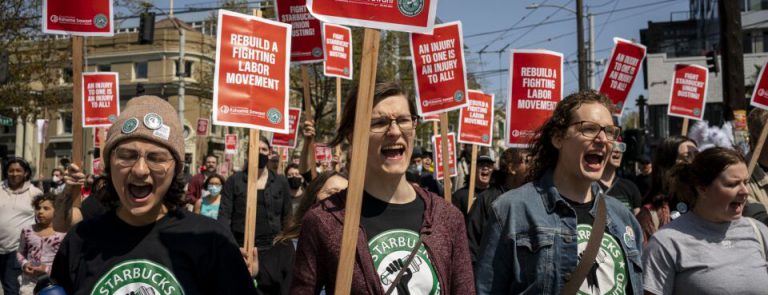
Following a wave of coffee shop unionizations in the greater Boston area, employees at three Somerville coffee shops have requested voluntary recognition from management to unionize with the New England Joint Board UNITE HERE union. The employees at Diesel Café, Bloc Café, and Forge Baking Company, which share management, are seeking structural changes such as better frameworks for raises, sick leave, time off, and management communication. The organizing committee represents about fifty employees across the shops.
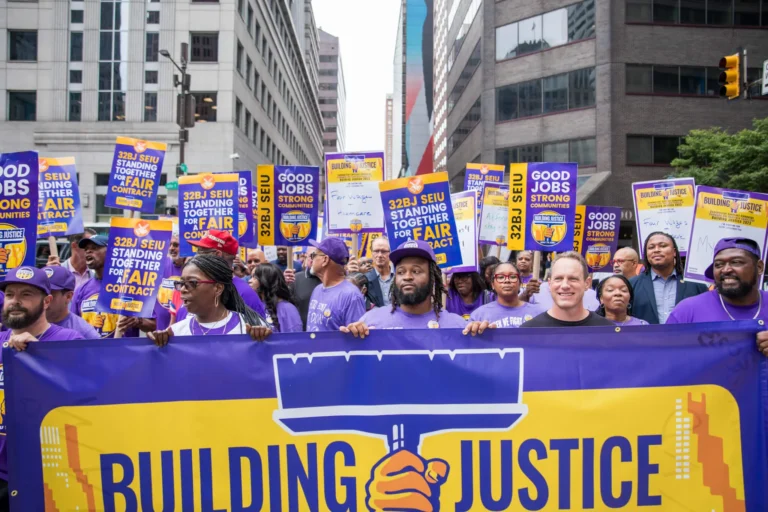
A group of unions have called on the Federal Trade Commission to use antitrust laws against companies such as Google, Amazon, and Uber that are weakening worker competitive power. Targeted practices include worker misclassification, widespread use of temporary workers, and arbitration agreements. Speakers at a joint workshop between the unions, the Justice Department, and the FTC included the Teamsters, SEIU, and the CWA. The union speakers emphasized that the proliferation of worker classifications meant to avoid unionization is unjustifiable anti-competitive behavior and that the FTC should address the “fissured workplace.”



Daily News & Commentary
Start your day with our roundup of the latest labor developments. See all
October 2
Gov. Newsom signs bill regulating AI in workplace; federal judge blocks Trump's $100,000 H-1B visa fee.
October 1
Senate confirms Keith Sonderling as Labor Secretary; Amazon warehouse workers launch an unfair labor practice strike.
September 30
Harvard grad union wins in First Circuit; AI data trainers initiate misclassification suits; Trader Joe’s found liable under ERISA.
September 29
Unions, AI companies, and private equity firms form a new coalition to shape data center policies; unions express support for the Paramount-Warner Bros. merger.
September 28
The Protect College Sports Act nears passage in the Senate; San Francisco municipal workers agree to contract extensions.
September 27
The Trump Administration reaches a settlement with federal unions on reduction in force actions; the United Auto Workers file an en banc petition seeking review of a Second Circuit decision regarding labor arbitrations.