

Verizon workers took to the picket line yesterday, as their months-long contract dispute with the telecommunications conglomerate reached a head. Yet there may be more at stake than better wages and job security for the 36,000 striking workers. As Noam Scheiber and Brian X. Chen of the New York Times put it, the strike has “brought into sharp relief one of the most fundamental questions facing the United States: Can an economy in the throes of dizzying technological change be a source of new middle-class jobs for blue-collar workers?” Scheiber and Chen note that “[o]ver 99 percent of the striking employees work on the so-called wireline side of [Verizon’s] business” — “a business where growth is slow or declining, as more and more consumers give up landlines and traditional subscription television” — whereas Verizon’s “wireless business, which is largely not unionized and where wages and benefits for rank-and-file workers are lower on average, is booming and highly profitable.” However, “these broad trends obscure some of the ways that Verizon could sustain and expand good-paying work even on the wireline side,” such as by expanding its fiber-optic broadband service. Both “the union and the company agree” that broadband networks “can serve as a foundation for sustaining desirable jobs,” as “there continues to be great demand for [Verizon’s] broadband service, where margins are quite high.” Yet Verizon has proven reluctant to double down on its investment in broadband — which is why some have called on the government to step in and provide “appropriate incentives” to carriers to expand their broadband networks. Indeed, “[g]iven the potential social benefits of a broadband expansion — in terms of both jobs for those working on the network and opportunity for those using it — many experts see a rationale for a government role in at least nudging the process forward, even if the economics are too challenging for private carriers to undertake on their own.”
Yesterday was a big day for Democratic presidential hopeful Bernie Sanders, as he not only joined striking Verizon workers on the picket line, but also received the endorsement of NYC’s transit workers union. (Sanders even picked up a shoutout, albeit a less-than-glowing one, from Verizon CEO Lowell McAdam.) Per the New York Daily News, yesterday’s endorsement by Transit Workers Union Local 100 — which represents some 42,000 workers — was “nearly unanimous.” Nevertheless, as Sanders and Hillary Clinton gear up for New York’s primary election on Tuesday, Clinton retains a strong lead in both union endorsements and polls of Empire State voters. And Reuters reports that Clinton, not to be outdone by Sanders’ entreaties to the labor movement, showed up to support workers picketing in front of a Verizon store in Manhattan.
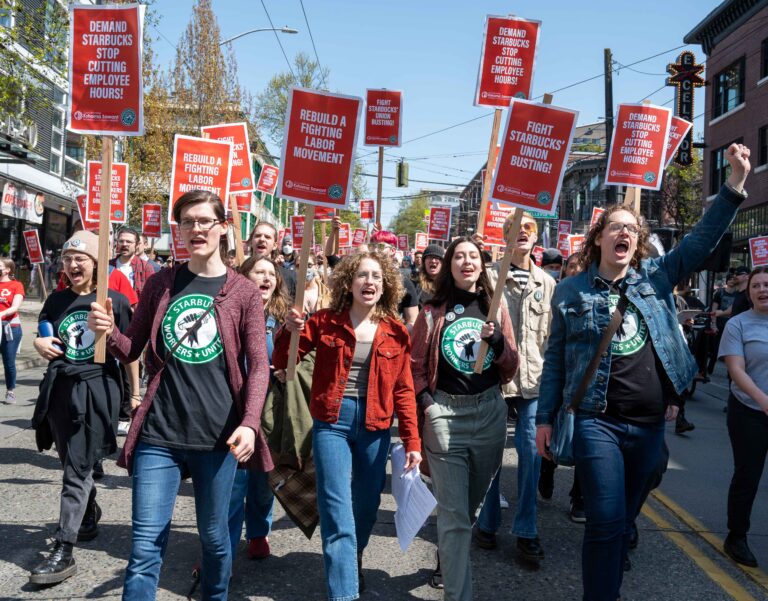
Verizon workers and presidential candidates won’t be the only ones picketing today. As reported by the Washington Post and The Guardian, tens of thousands of fast-food workers are walking off the job to continue the fight for a $15 minimum wage. Today’s action — which is planned to take place in over 300 U.S. cities — is focused on fast-food giant McDonald’s, but is supported by workers of many different employers. “No matter where we work, McDonald’s still affects our lives,” said Stephanie Rodriguez, who works for clothing-retailer Forever 21 but contends that McDonald’s “sets the standard” for other large corporations. “I am a member of the Fight for $15 because it’s all about workers — about creating an economy that works for us all.” And although the movement has won a number of important victories in recent months, its aim is not only to achieve a $15 nationwide wage, but also, perhaps, to achieve something bigger: unionization. “I will fight for [unionization] every day,” said Rebecca Cornick, a 61-year-old line cook at Wendy’s. “It’s important for us to have dignity on the job. Before we won the $15, I didn’t think it was possible, but when we won, that boosted my self-confidence and it made me want to fight even more for the union.”



Daily News & Commentary
Start your day with our roundup of the latest labor developments. See all
October 23
Employers increasingly shift health care costs onto workers and NYC proposes placing restrictions on fully automated customer service.
October 22
SCOTUS declines Wilcox appeal; Penn State research assistants win bargaining rights; SEIU sued over military leave firing.
October 21
DOL withdraws tipped-worker rule; Instacart settles hiring-bias claims; Phillips 66 locks out New Jersey refinery workers.
October 20
Korean unions oppose labor exemption bill; Portland city workers prepare for strike; UPenn grad student union looks to dismiss university filing
October 19
FDA reverses course on policy prohibiting off-duty union activity; FAA and NATCA reach deal to secure pay increase for air traffic controllers.
October 18
Federal judge again halts cancellation of the Bureau of Prisons’ CBA; tabletop gaming workers face roadblocks in union recognition.