
Nicole Berner serves as SEIU’s General Counsel and is a partner at James & Hoffman in Washington, DC. Dora Chen, SEIU Associate General Counsel, is SEIU's counsel for political programs.

Dora Chen, SEIU Associate General Counsel, is SEIU’s counsel for political programs.
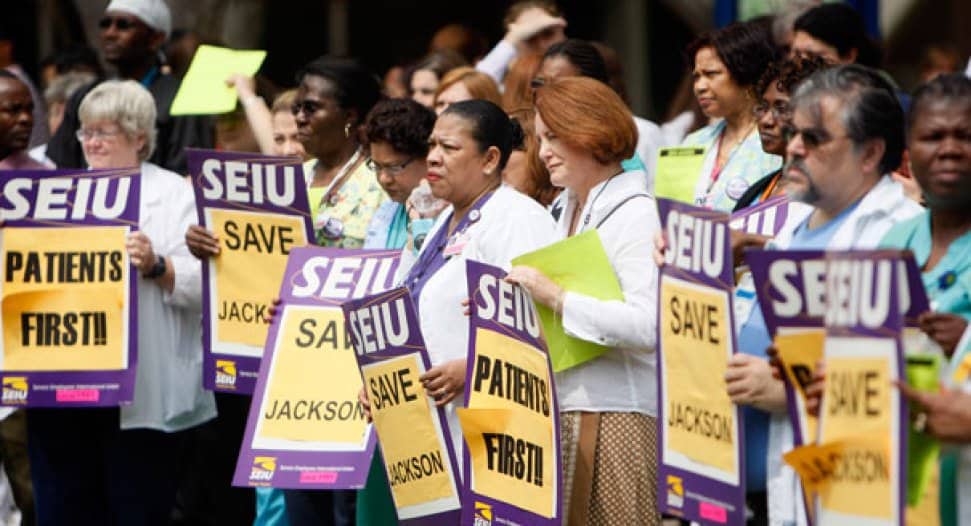
Today in Milwaukee, the site of the upcoming Democratic National Convention, SEIU President Mary Kay Henry laid out our union’s bold vision for an inclusive labor law regime that would empower millions of workers to form unions and rebalance our economy away from entrenched corporate interests. SEIU members and the workers in the Fight for 15 and a Union movement are demanding a system where everyone has the opportunity to join a union, no matter where they work.
Under current law, workers in the fastest growing sectors of our economy are excluded from the protections of labor law due to the continuing impact of institutional racism in the 1930s. According to President Henry, our labor laws “excluded domestic workers and farm workers. They excluded care workers and service workers. They excluded all the industries dominated by women, immigrants, and people of color. And the racist consequences of those laws live on.” As those of us in the labor movement are painfully aware, millions of workers across industries are effectively blocked from forming unions in their workplaces due to the steady erosion of the right to organize and the right to strike over the last 80 years.
Unions for All is SEIU’s four-pronged demand of all candidates running for public office. It has the fundamental goal of bringing all workers — white, Black, brown and Asian, those who have always been excluded and those who are unable to exercise their rights — under the protection of our labor law system so that we can begin to rebuild our society and economy together and demand bold, progressive change.
First, our laws must bring employers, workers and government together at industry-wide bargaining tables to negotiate wages, benefits, and working conditions. We have seen this done successfully with the New York fast food wage board, which was brought about by the brave fast food workers who first went on strike in 2012 demanding $15 and a union. Sectoral bargaining or wage boards are among the best ways to address our fissured economy, and stop the race to the bottom created when union employers are pitted against low-road corporations.
Second, we must change the law to establish the National Labor Relations Act as the floor rather than the ceiling for laws governing worker organizing, allowing states and cities to empower workers to join together in a union beyond the limits of federal law. Federal preemption should be lifted for states that want to pass laws that expand workers’ rights to organize, while maintaining it as a floor for workers in all other states. “Federal labor law should be a floor that gives workers the foundation they need to advocate for themselves. It shouldn’t be a ceiling that holds workers down.”
Third, we must ensure that every public dollar spent is used to create good, union jobs and that every federal worker and contractor makes at least $15 an hour and has the opportunity to join a union. Our tax dollars should never be used to fund jobs that are anything but family-sustaining jobs with a path to forming a union.
Fourth, good union jobs must be at the center of any major economic proposal to fix the myriad of problems facing our economy and society. Just as the Green New Deal centers good union jobs and a just transition to a clean economy, proposals such as debt-free college and Healthcare for All must also ensure that the workers in those industries have a path to forming unions.
President Henry made clear that to earn our endorsement, a Presidential candidate must embrace a Unions for All agenda:
Many of the 2020 presidential candidates have been out on strike lines with fast food workers. That’s good. But to truly transform those workers’ lives, we need the candidates to commit to bring McDonald’s, Wendy’s and Burger King to a national fast-food industry bargaining table that will lift wages and improve working conditions for fast-food workers across the nation, in the way that only a president can.
Many of the 2020 presidential candidates talk about banning right to work laws… or tweaking the rules to make it a little bit easier for workers to join unions. But to truly improve the lives of working people, we need all of them to think even bigger. We need to make it possible for all workers to join together across employers, industries, and geographies… not workplace by workplace by the dozens, but by the hundreds of thousands and millions. We need workers who have been historically excluded from labor law to be included.
In this moment of crisis for American workers, SEIU is demanding that Presidential candidates embrace and declare that transformational change is needed.






Daily News & Commentary
Start your day with our roundup of the latest labor developments. See all
March 13
Republican Senators urge changes on OSHA heat standard; OpenAI and building trades announce partnership on data center construction; forced labor investigations could lead to new tariffs
March 12
EPA terminates contract with second-largest union; Florida advances bill restricting public sector unions; Trump administration seeks Supreme Court assistance in TPS termination.
March 11
The partial government shutdown results in TSA agents losing their first full paycheck; the Fifth Circuit upholds the certification of a class of former United Airline workers who were placed on unpaid leave for declining to receive the COVID-19 vaccine for religious reasons during the pandemic; and an academic group files a lawsuit against the State Department over a policy that revokes and denies visas to noncitizens for their work in fact-checking and content moderation.
March 10
Court rules Kari Lake unlawfully led USAGM, voiding mass layoffs; Florida Senate passes bill tightening union recertification rules; Fifth Circuit revives whistleblower suit against Lockheed Martin.
March 9
6th Circuit rejects Cemex, Board may overrule precedents with two members.
March 8
In today’s news and commentary, a weak jobs report, the NIH decides it will no longer recognize a research fellows’ union, and WNBA contract talks continue to stall as season approaches. On Friday, the Labor Department reported that employers cut 92,000 jobs in February while the unemployment rate rose slightly to 4.4 percent. A loss […]