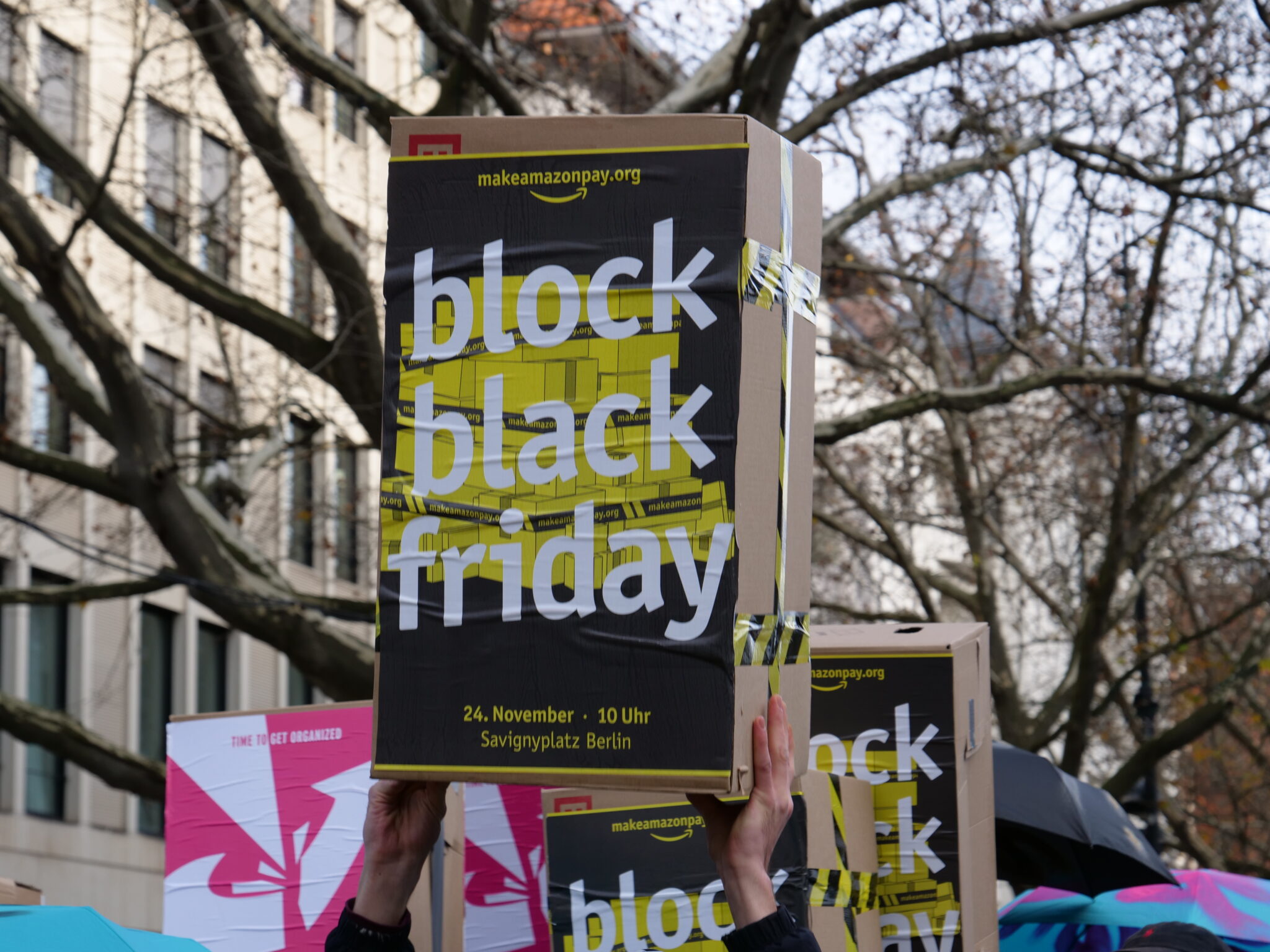

In today’s News and Commentary, Black Friday strikes took place around the world with Amazon workers in over 30 countries walking out and four hundred Macy’s workers beginning a three-day strike last Friday, and Portland’s teachers union reaches a tentative deal.
Americans’ Black Friday activities had an international flair to them this year as Amazon workers in over 30 countries walked out on strike last Friday. The UNI Global Union’s “Make Amazon Pay” campaign is calling for fair pay and the right to join unions. Black Friday marked the Coventry, UK warehouse’s 28th day of industrial action this year. Workers there signed up 1,200 members and submitted a formal bid for union recognition before the company hired an additional 1,000 workers in a move many see as an attempt to union bust. German trade union, Verdi, estimated that nearly 2,000 workers from six fulfillment centers around Germany walked out. Spanish workers are calling for a one-hour strike on each shift during “Cyber Monday.” The French protests included blocking Amazon parcel lockers with posters and barricade tape. Amazon workers in India used the strike to demand sustainability commitments from the company and to shed light on the mental and physical repercussions of Amazon’s performance monitoring systems, among other demands. Amazon spokespeople around the world told customers that the strike would not disrupt distribution, but it remains yet to be unseen if they were able to deliver on this promise.
Nearly 400 Macy’s workers in Washington state began a three-day strike on Black Friday, protesting alleged unfair labor practices and refusal to agree to a new contract. The workers, represented by UFCW 3000, are calling for increased wages and better worker protections. Negotiations with the retail giant stalled recently over issues surrounding shoplifters. In October, 96% of workers voted in favor of the strike.
Teachers in Portland, Oregon reached a tentative agreement late Sunday night, returning the union and 45,000 students to the classroom today after three weeks of striking. As Linh reported, the Portland Association of Teachers (PAT) went on strike on November 1, calling for wage increases, facility improvements, and mental health programs. The tentative deal addresses classroom size, teacher salaries, and health and safety demands. If ratified, educators can expect a 13.8% cumulative cost-of-living increase over the life of the three-year contract. Teachers will also see an increase of 90 minutes per week in planning time and reduced class sized. The tentative agreement must still be approved by union members and the school board.




Daily News & Commentary
Start your day with our roundup of the latest labor developments. See all
July 24
EEOC drops request for UPenn's Jewish staff; Starbucks defeats mail-in ballots; and Mamdani appoints Lina Khan.
July 23
Ninth Circuit affirms ban of transphobic books in school; leading demographer warns of impending labor shortage.
July 22
EDNY strikes down state labor board law; D.C. Circuit applies Loper Bright to NLRB; Joint employer bill reaches the House floor.
July 21
Fifth Circuit transfers an Anheuser-Busch NLRB case to the Eleventh Circuit; a new report makes the case for tripling union membership.
July 20
New York City weighs banning horse carriages despite union opposition; public defenders go on strike; cinema workers stage walkout.
July 17
Canadian wildfires endanger rail workers; 26 Meta employees allege targeted layoffs for those on paid leave; FIFPRO pushes for more rigorous heat protections for players.