
Marina Multhaup is a Senior Associate at Barnard, Iglitzin & Lavitt—a law firm in Seattle, Washington, that represents unions, and a former student member of the Labor and Employment Lab at Harvard Law.
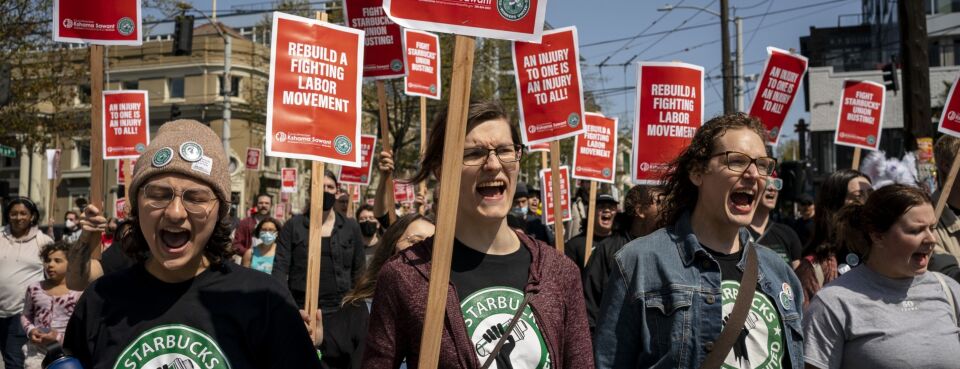
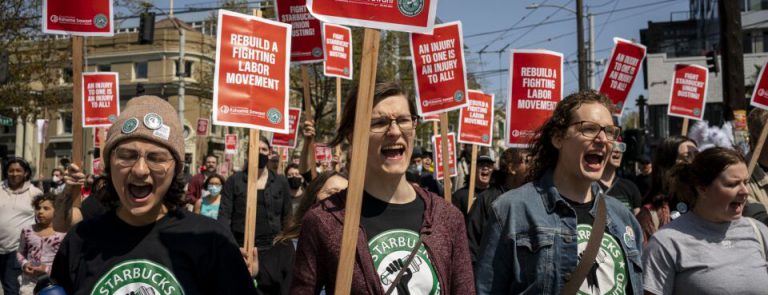
Baristas at the 4th & Diagonal Starbucks store in Seattle, Washington, started organizing with Workers United in early 2022. What followed over the next four years, culminating in last week’s Board decision, exemplifies the state of modern-day labor law: broken, backwards, and antithetical to workers’ interests. Through both Biden and Trump’s Labor Boards, the combination of delay, arcane procedures, and obtuse decision-making killed the union drive and failed these workers. While not unique, it is a striking microcosm of the system we know doesn’t work but still hang onto.
The Union petitioned to represent the 4th & Diagonal workers on May 13, 2022. The regional labor board directed a mail-ballot election, finding that appropriate under the then-governing covid-era test for mail ballot elections. Starbucks filed a Request for Review of that decision, which sent the issue up to the federal Labor Board in D.C., and impounded the workers’ ballots while the Board was deciding. The request for review, even with a Biden-appointed democratic majority, languished. The election date came and went, with no response. The workers had voted but their ballots sat in a regional office, uncounted. Finally on September 29, 2022, the Board issued a decision, rejecting Starbucks’ request for review but changing the standard for when mail ballot elections were appropriate, given the wind-down of the pandemic. The Board needed an election which raised this issue to adjust the legal standard, and 4th & Diagonal paid the price. The ballots were counted in October, six months after the store initially filed for an election.
The problems for 4th & Diagonal did not stop there. The tally of ballots revealed four votes for the Union, four against, and Starbucks challenged two additional ballots because they did not have postmarks. That meant that the election outcome hinged on the two challenged ballots—if they were determined to be appropriately cast, they would be opened and their votes counted. If they were determined invalid, they would not be counted, and the Union would lose the election with a tied vote. Starbucks proceed to launch a barrage of unfounded attacks against the election, filing four election objections claiming that local labor board officials engaged in “misconduct,” communicated with the Union “ex parte,” and accused the Union of “unlawful ballot harvesting.” A hearing had to be held to consider Starbucks’ challenges and objections. Still the 4th & Diagonal workers had no answers, and no union.
A hearing was held on November 1, 2022. During the hearing the two workers who cast the challenged ballots testified that they had received their mail ballots, filled them out, signed them, sealed them, and then dropped them off at the local labor board regional office instead of mailing them in. One worker had her boyfriend drop off her ballot into a ballot receptacle at the labor board. Another hand-delivered his ballot to the local labor board, who accepted his ballot and photocopied the front and back of it as a receipt for him. There was no evidence that these workers had any contact with the Union, or the local labor board, or did anything inappropriate. They simply cast their votes and then decided to drop off their ballots directly to the labor board office, a ten-minute drive from their workplace, instead of putting them in the mail.
The Hearing Officer dismissed all of Starbucks’ objections as unfounded. With regards to the challenged ballots, the Hearing Officer concluded the secrecy of the two ballots was uncompromised, and that there was no requirement in the election instructions that ballots had to be mailed—the only requirement was that ballots had to be “received” by the regional office by a certain date and time. As such, the challenges were dismissed and the ballots were ordered to be counted.
But Starbucks appealed to the Regional Director. That appeal sat for months. The ballots also sat, still uncounted. The Regional Director affirmed the below decision in April, 2023—dismissing all of Starbucks’ objections and challenges, finding that there is no provision, in either the Board’s Rules and Regulations or its Casehandling Manual, that prohibits the counting of hand-delivered mail ballots timely received by the regional office. At that point, the workers at 4th & Diagonal had petitioned to unionize a full year prior, with no resolution.
Starbucks appealed to the full labor board in DC. The appeal, to Biden’s Board, sat undecided for years. No decision was made in 2023 or 2024. Trump was elected, and his firing of Gwenn Wilcox hobbled the Board for months. On July 22, 2026, Trump’s new Board, with its anti-worker majority, took up the opportunity and issued its decision.
A divided Board reversed the Regional Director and the Hearing Officer. The full Board agreed that there had been no bad behavior in the case: no evidence of misconduct, no evidence of ex-parte communication, no evidence of “ballot harvesting.” But, in a stunning move, the majority ruled the workers’ ballots should not be counted because they were hand-delivered to the regional office. The Board could not cite any rules that the workers broke. It relied on one line of the election instructions which stated, “mail the ballot immediately, no postage is necessary,” to rule that the workers did not follow the instructions, and their punishment would be the removal of their federal right to freely choose whether to unionize. The dissent argued, rightfully, that there was no prohibition on the hand delivery of mail ballots, and thus because there was no prohibition, the practice was implicitly permitted. In response, the Board majority offered exactly three words: “[o]bviously, we disagree.”
The dissent reiterated that the two workers in question followed all prescribed procedures: they completed, signed, and sealed their mail ballots according to the Board’s explicit instructions. The dissent emphasized there was “absolutely no evidence that either ballot was tampered with, left unsecured, or handled by the parties…”. And he repeated that there is “nothing” in the Board’s rules, manual, or election documents that prohibited voters from hand-delivering ballots, nor is there any Board precedent directly on point. He concluded: “Unlike my colleagues, I see no valid policy reason to disenfranchise two eligible voters who made a good-faith attempt to submit their ballots in a timely manner, especially where (1) they followed the Board’s well-established procedures for completing, sealing, and signing their ballots, and (2) there is no dispute as to the authenticity and integrity of their ballots.”
The Trump Board’s decision will have disenfranchising effects on workers’ right to vote going forward. Under the Board’s logic, if a worker deviates from even un-written voting procedures, their votes can be dismissed, even if everyone agrees they are otherwise valid votes.
This is a lawless and destructive decision, for sure. But the Board had failed the 4th & Diagonal workers long before it issued this decision. The years that the workers were left in limbo by the Biden board destroyed their union organizing drive and gave the Trump Board the opportunity to decide the case. In late 2025, Starbucks closed the 4th & Diagonal location, and its workers were scattered to other stores or left the company. Because the Union had never been certified, it did not have any rights to protest the closure. Earlier this year, a different, non-union coffee company took over the location.


Daily News & Commentary
Start your day with our roundup of the latest labor developments. See all
October 6
Protect College Sports Act dampens athlete unionization outlook; Stanford RA union decides to withdraw petition
October 5
Delaware bans captive audience meetings; EEOC settles remote work national origin discrimination claim; First Circuit stays enforcement order in VA's dispute with AFGE.
October 4
Boston nurses announce open-ended strike; federal judge restores federal prison workers' union protections; St. Louis workers form the first movie theater union in Missouri.
October 2
Gov. Newsom signs bill regulating AI in workplace; federal judge blocks Trump's $100,000 H-1B visa fee.
October 1
Senate confirms Keith Sonderling as Labor Secretary; Amazon warehouse workers launch an unfair labor practice strike.
September 30
Harvard grad union wins in First Circuit; AI data trainers initiate misclassification suits; Trader Joe’s found liable under ERISA.