

Swap Agrawal is a student at Harvard Law School.
In this weekend’s news and commentary, the UAW continues to make progress with the Big Three, and the AMPTP returns to the negotiating table with SAG-AFTRA.
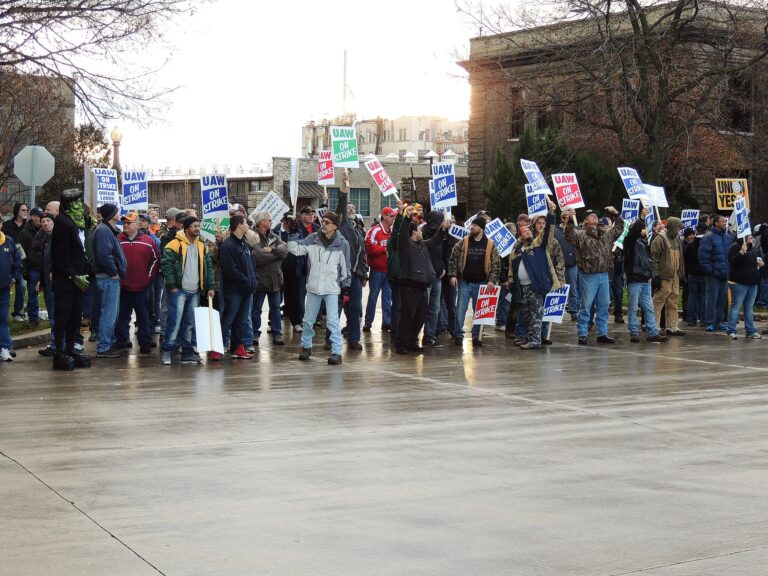
On October 20, the UAW said that it had received new contract offers from two of the Big Three automakers. Both Stellantis and General Motors reported that they were raising their offers to match the 23% wage hike and other benefit improvements previously offered by Ford. UAW gave public updates on Friday to its members on where things stand at Stellantis, General Motors, and Ford. UAW President Shawn Fain acknowledged that the automakers have offered record contracts and did not call for any more plant walkouts. However, he said the union needs more before it can agree to a deal. “There is more to be won,” Fain said during an online broadcast. “These are already record contracts, but they come at the end of decades of record decline. So it’s not enough to be the best ever, when auto workers have gone backwards over the last two decades. That’s a very low bar.” UAW initially demanded 40% wage increases, but Bloomberg reports that the union is now looking for a 25% increase. Fain indicated that a deal is close. “We’ve got cards left to play and they’ve got money left to spend,” Fain said. “That’s the hardest part of the strike. Right before a deal is when there is the most aggressive push for that last mile.”
On October 21, SAG-AFTRA and the AMPTP issued a joint statement announcing that they will resume bargaining on Tuesday, October 24. The two sides are returning to the table as pressure is mounting on the union to reach a deal with the studios, as demonstrated by the failed proposal that George Clooney, Ben Affleck, Scarlett Johansson, and other A-list actors presented to SAG-AFTRA leadership last week. The announcement came shortly after Fran Drescher published an article in Deadline commemorating the 100th day of SAG-AFTRA’s strike and calling for the AMPTP to return to the table. She said that SAG-AFTRA members are in a “David-and-Goliath, righteous fight for the future of our profession and our industry.” She also noted that when negotiations between the union and the AMPTP resumed on October 2, the CEOs gave the union only two full-day and three half-day bargaining sessions to resolve contentious issues such as streaming rights, AI, minimum compensation increases before the AMPTP walked away again on October 11. It remains to be seen whether this bargaining session will be more productive.




Daily News & Commentary
Start your day with our roundup of the latest labor developments. See all
March 13
Republican Senators urge changes on OSHA heat standard; OpenAI and building trades announce partnership on data center construction; forced labor investigations could lead to new tariffs
March 12
EPA terminates contract with second-largest union; Florida advances bill restricting public sector unions; Trump administration seeks Supreme Court assistance in TPS termination.
March 11
The partial government shutdown results in TSA agents losing their first full paycheck; the Fifth Circuit upholds the certification of a class of former United Airline workers who were placed on unpaid leave for declining to receive the COVID-19 vaccine for religious reasons during the pandemic; and an academic group files a lawsuit against the State Department over a policy that revokes and denies visas to noncitizens for their work in fact-checking and content moderation.
March 10
Court rules Kari Lake unlawfully led USAGM, voiding mass layoffs; Florida Senate passes bill tightening union recertification rules; Fifth Circuit revives whistleblower suit against Lockheed Martin.
March 9
6th Circuit rejects Cemex, Board may overrule precedents with two members.
March 8
In today’s news and commentary, a weak jobs report, the NIH decides it will no longer recognize a research fellows’ union, and WNBA contract talks continue to stall as season approaches. On Friday, the Labor Department reported that employers cut 92,000 jobs in February while the unemployment rate rose slightly to 4.4 percent. A loss […]