
Travis Lavenski is a student at Harvard Law School.
In today’s news & commentary, strippers in Los Angeles will need to wait to determine if they have won their union election; the NLRB issues complaint against Verizon for terminating a worker engaged in union activity; and workers’ rights are on the ballot this Election Day.
Strippers in North Hollywood, California will have to wait a little longer to know if they won their union election, Bloomberg reported Monday. As I reported for OnLabor earlier this year, strippers at the Star Garden Topless Dive Bar have been attempting to organize after the worker’s concerns over safety conditions fell on deaf ears. After the employer refused to voluntarily recognize the union, the workers petitioned the NLRB for a union election; the Board scheduled the election to take place yesterday, November 7. The election results were inconclusive, however, as all but one of the worker’s ballots was challenged. The employer argues that the challenged votes were cast by independent contractors, making them ineligible. Although the official election results will not be determined until the Board resolves the issue, workers at the club are reportedly celebrating as they believe they have the votes to form the union.
The NLRB issued a complaint against Verizon Wireless yesterday, alleging the April 2022 termination of Jesse Mason was motivated by anti-union animus. Mason, who was reportedly inspired by labor victories at Starbucks, was the main person attempting to organize his Verizon store in Seattle. Mason, who had no disciplinary record while working at Verizon, was suddenly subjected to increased scrutiny after other stores in the Seattle area announced their intent to organize. Then, on the first work day after Mason was photographed celebrating the union victory of the other Verizon stores, he was terminated by the company. The Board is seeking to reinstate Mason with backpay. The hearing is scheduled for February 14, 2023.
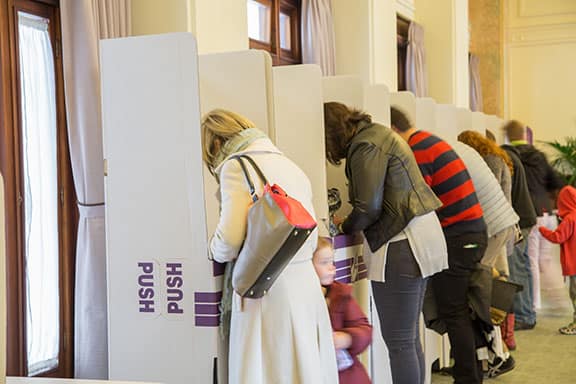
Finally, Election Day is here, and workers’ rights are on the ballot. Two states along with Washington, D.C., will be voting whether to increase the minimum wage for their workers. In Nevada, voters will decide on whether to increase the minimum wage to $12/hour by 2024, with annual inflation adjustments. In Nebraska, voters decide whether to increase their minimum wage to $15/hour by 2026 with inflation adjustments. And in our nation’s capital, voters will decide whether to raise tipped worker’s baseline hourly pay from $5.35/hour to $16.10/hour by 2027. Moreover, two states will be voting on questions with major implications for organized labor. In Illinois, voters will decide whether to approve of a state Constitutional Amendment to grant a “fundamental right to organize and bargain collectively” and to prohibit the passing of any law that “interferes with, negates, or diminishes” this right. This amendment would effectively protect workers against future attempts to pass anti-worker legislation. In Tennessee, however, voters will decide whether to enshrine right-to-work language in its state Constitutional Amendment. Moreover, the stakes are high for the federal Congressional races today, as a Republican takeover of one or both chambers would all but surely lead to an attempt to introduce an influx of anti-worker legislation.


Daily News & Commentary
Start your day with our roundup of the latest labor developments. See all
September 22
Judge blocks ICE raids in Alabama; Chicago hotel workers vote to strike; AutoZone workers look to create first union
September 21
In today’s News and Commentary, the Seventh Circuit raises the bar for the NLRB to obtain preliminary injunctions, the California Primary Care Association sues SEIU-UHW for racketeering, and the Seventh Circuit finds that an employer group and think tank do not have standing to challenge an Illinois law banning captive audience meetings. On Friday, the […]
September 20
Culinary Workers Union members protests union leadership; lawsuit against OpenAI and Microsoft reveal internal concerns about the threat of AI training to human labor.
September 17
Unions push to block Google from buying Spirit Airlines employment records; U.S. Department of Labor sues Oklahoma coffee chain over alleged wage violations.
September 16
Trump nominates Catherine Eschbach as EEOC general counsel; NLRB declines to resolve union work-assignment dispute; Allina Health physicians begin four-day strike.
September 15
Documents reveal the inner workings of Amazon's union avoidance program; Washington state public sector unions reach tentative deals amid a difficult bargaining cycle; hundreds of Nevada Culinary Union members protest their union's health care changes.