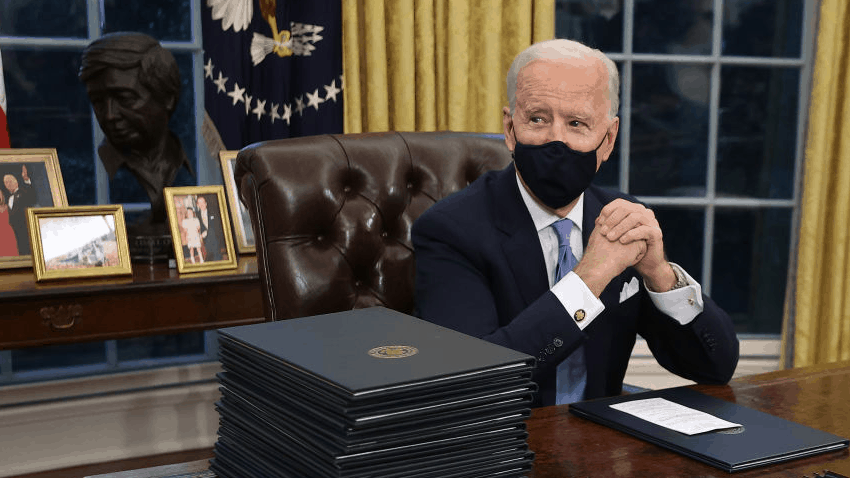

Mackenzie Bouverat is a student at Harvard Law School.
In January, Judge Edward M. Chen of the U.S. District Court for the Northern District of California certified a class of more than 4,800 Uber drivers who alleged they were misclassified as independent contractors rather than employees under California law. The certification, he held, was not precluded by California’s Proposition 22, as the measure was not not retroactive. In a motion for clarification, Uber argued the court’s retroactivity judgment was inappropriate at the class certification stage. Last Friday, Judge Chen granted the order for clarification over the drivers’ objections, writing that “withholding adjudication of the merits of the retroactivity claim does not negate class certification — the issue of the retroactivity of Proposition 22 is a matter that may properly be decided on a class-wide basis.”
In his discretionary spending request, President Joe Biden has proposed spending $14.2 billion on the U.S. Labor Department for the 2022 fiscal year—a 14% increase in the agency’s current annual budget, subject to Congressional approval. The proposal allocates $2.1 billion for workers’ protection subdivisions of the Department of Labor (including the Wage and Hour Division and Occupational Safety and Health Administration). This figure amounts to $304 million more than was allocated to these subdivisions during the last fiscal year. With respect to the former division, the White House recommends that the funding be directed at investigating misclassification of workers as independent contractors rather than employees, as well as violations of equal employment obligations of Federal contractors. $285 million is requested for registered apprenticeship programs—$100 million more than the current annual funding—and is aimed at expanding paid vocational training opportunities for women and people of color. Finally, President Biden proposed a 6% increase for Workforce Innovation and Opportunity Act state grants directed at employment services and job training for workers dislocated due to the coronavirus pandemic. A more detailed budget request featuring specific funding requests for DOL subagencies is anticipated.



Daily News & Commentary
Start your day with our roundup of the latest labor developments. See all
September 25
Healthcare workers rally to restore legal status for TPS holders; nurses at a Maine hospital overwhelmingly vote to form their union despite alleged aggressive union busting tactics.
September 24
NLRB abandons rule for offensive conduct during protected activity; New York home care workers seek a union election; maritime deck officers endure long fight for first contracts.
September 23
DoorDash settles delivery-worker pay claims; Philadelphia school workers win new contract; stock gains spur retirements.
September 22
Judge blocks ICE raids in Alabama; Chicago hotel workers vote to strike; AutoZone workers look to create first union
September 21
In today’s News and Commentary, the Seventh Circuit raises the bar for the NLRB to obtain preliminary injunctions, the California Primary Care Association sues SEIU-UHW for racketeering, and the Seventh Circuit finds that an employer group and think tank do not have standing to challenge an Illinois law banning captive audience meetings. On Friday, the […]
September 20
Culinary Workers Union members protests union leadership; lawsuit against OpenAI and Microsoft reveal internal concerns about the threat of AI training to human labor.