

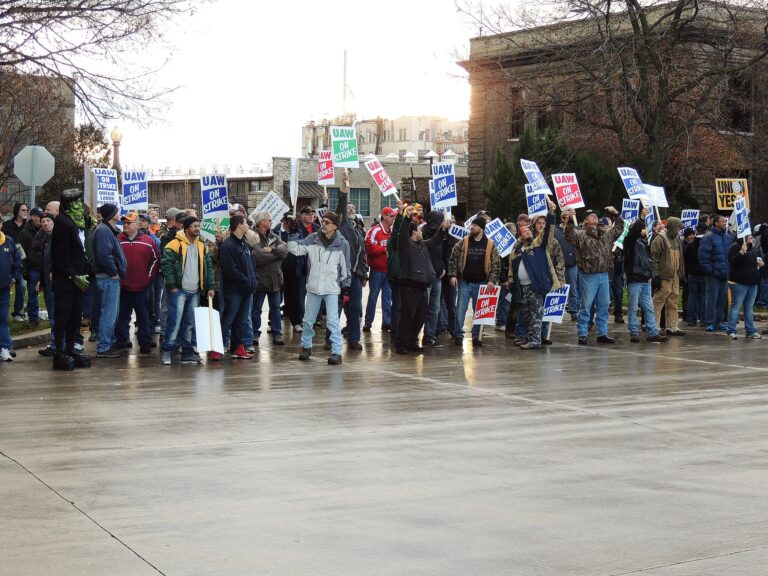
The New York Times reports that yesterday, leaders of the United Automobile Workers Union (UAW) approved a tentative four-year agreement with General Motors. Under the agreement, workers will earn wages equal to those agreed upon in the union’s recently-bargained agreement with Fiat Chrysler. The deal also contemplates wage parity for entry-level workers (achieved using the same wage progression formula as with Fiat Chrysler) and pay raises for senior workers (to about $29/hour). Also favorable to the union is a provision that provides for a more generous signing bonus than what the Fiat Chrysler workers were given ($8,000, double the amount received by Fiat Chrysler workers). Finally, the contract provides that the company will invest $1.9 billion, which is estimated to retain or create some 3,300 jobs at various GM sites. Readers can see the full GM deal here. The contract, if approved in a vote by hourly workers, would cover more than 52,000 employees. Politico reports that voting by union members is expected to begin today.
Politico highlighted that the UAW Union is also pressing forward with an election that will decide whether 165 employees at Volkswagen’s Chattanooga plant will unionize. Although Volkswagen plans to “respect [the] employees’ right to petition and vote” and has promised to remain neutral, company officials did express disappointment that the union is continuing with its efforts even as the company is faced with the task of recovering from its recent emissions scandal. Seemingly indifferent to Volkswagen’s lack of appreciation for the “unfortunate timing” of UAW’s drive, the union is pushing for an election by November 6.
According to the Wall Street Journal, Indonesia has agreed to discard various labor rules that have stirred controversy since their proposal in June. Introduced by the Manpower Ministry with the aim of protecting Indonesia’s local labor force, the rules would have required business executives to get work permits to travel to Indonesia, even if coming for just one day to attend a single meeting. Non-resident board members and directors of companies operating in Indonesia would also have been required to obtain work permits, even absent plans to travel there. Finally, the rules would have required employers to hire 10 local employees for every foreign employee. The ministry recently announced that it has decided to scrap the rules in response to irked companies, business associations, and foreign investors, all of whom predicted that the rules would hurt the economy.




Daily News & Commentary
Start your day with our roundup of the latest labor developments. See all
March 26
Supreme Court hears oral argument in an FAA case; NLRB rules that Cemex does not impose an enforceable deadline for requesting an election; DOL proposes raising wage standards for H-1B workers.
March 25
UPS rescinded its driver buyout program; California court dismissed a whistleblower retaliation suit against Meta; EEOC announced $15 million settlement to resolve vaccine-related religious discrimination case.
March 24
The WNBPA unanimously votes to ratify the league’s new CBA; NYU professors begin striking; and a district court judge denies the government’s motion to dismiss a case challenging the Trump administration’s mass revocation of international student visas.
March 23
MSPB finds immigration judges removal protections unconstitutional, ICE deployed to airports.
March 22
Resurgence in salting among young activists; Michigan nurses strike; states experiment with policies supporting workers experiencing menopause.
March 20
Appeal to 9th Cir. over law allowing suit for impersonating union reps; Mass. judge denies motion to arbitrate drivers' claims; furloughed workers return to factory building MBTA trains.