

Funding for progressive groups — from economic think-tanks to immigrants’ rights advocates and Democratic campaigns — is in jeopardy following Supreme Court’s Janus decision, which will cost public sector unions an estimated tens of millions in revenue. The New York Times reported on the fallout yesterday, noting that major unions like SEIU have already scaled back their budget dramatically in anticipation of the decision. Progressive groups note that funding cuts stemming from Janus are not an existential threat, but nonetheless pose a significant constraint for a wide range of advocates for working-class people. Public-sector unions may also have to scale back spending on ballot-measures and Democratic candidates. Democrats might be right to fear Janus’ political spillover effects: a recent paper found that right-to-work laws decreased Democratic presidential vote share by 3.5 percent. Commenters from across the ideological spectrum — from Donald Trump to Professor Sachs — agree that depriving Democrats of campaign funds was Janus’ true purpose in the first place.
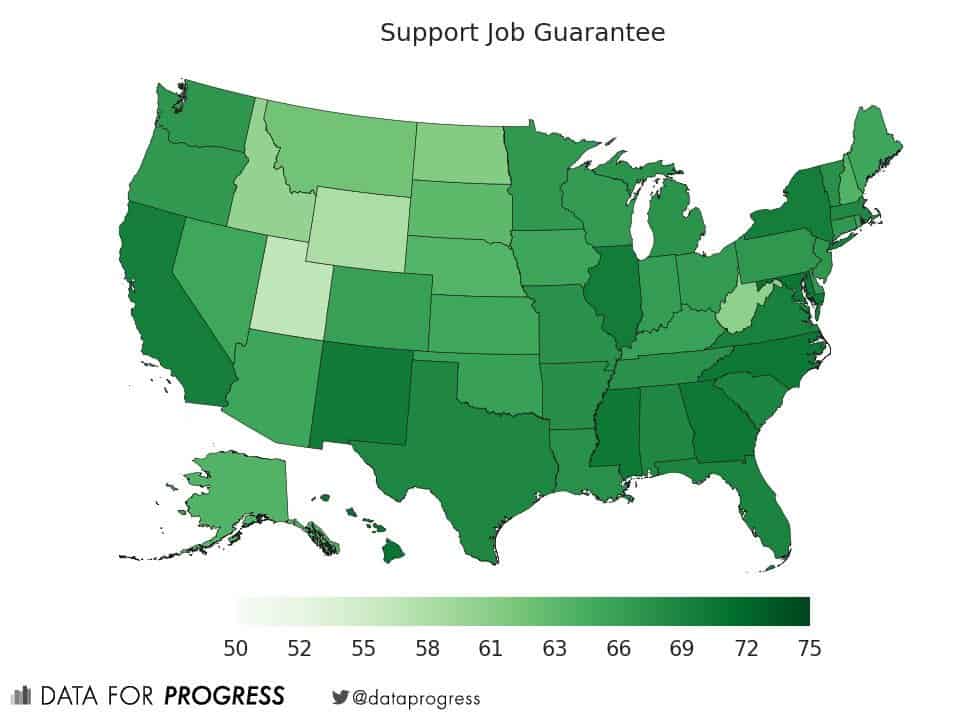
Democratic Socialist Alexandria Ocasio-Cortez’ stunning victory in a New York Congressional primary is reinvigorating recent debate within the Democratic Party about a federal jobs guarantee, which was a key part of her groundbreaking policy platform. Left-wing advocates see Ocasio-Cortez’ primary win as a vindication that working class voters want bold, left-wing proposals from Democrats (the Bronx and Queens district has one of the highest percentages of service-sector workers of Congressional districts across the country). Others have argued that Ocasio-Cortez’ policies will be too far left for voters in the Midwest. But Eric Levitz points out in New York that this conventional wisdom is at odds with promising polling: data from the Center for American Progress, an influential thinktank closely associated with the Democratic Party, shows that a “supermajority” of voters support federal jobs guarantee. Analysis from the left-wing Data for Progress finds support for CAP’s proposal among 67 percent of voters in rural zip codes.
New York City is taking unprecedented steps to raise wages for Uber and Lyft drivers, proposing a first-of-their-kind regulations that would establish a base wage of $17.22 per hour. Under the proposal, if drivers earnings fall below $17.22 per hour over the course of a week, the companies would be required to make up the difference; if they exceed $17.22 per hour, drivers would keep the premium. As Vail wrote yesterday, the City’s Taxi and Limousine Commission released a report analyzing a report analyzing the need to protect ride-sharing app drivers’ wages, finding that the median net hourly earnings in the industry were about $14.25 per hour. A disturbing spate of suicides by professional drivers recently drew attention to the acute economic precariousness ride-hail drivers face; despite working long hours, nearly a fifth of New York drivers for companies like Uber and Lyft earn so little they qualify for food stamps.
Apprehension is growing among progressives and workers’ rights advocates as Donald Trump prepares to name his nominee to replace Justice Anthony Kennedy on the Supreme Court. At the Times, Professor Jedediah Purdy argues that the new nominee will likely pose a serious threat to unions, workers’ rights, and legislative efforts to address economic equality. Purdy argues that recent cases, including Epic Systems and NFIB v. Sebelius, are part of a historical arc aimed at “dismantling the legal legacy of the New Deal,” essentially warning of a new Lochner era.
If that happens, it may well be because of conservatives “weaponizing the First Amendment” as Justice Kagan recently warned. That makes Professor Charlotte Garden’s new series at Take Care on the dergulatory First Amendment all the more essential. Check out the first post here.




Daily News & Commentary
Start your day with our roundup of the latest labor developments. See all
October 14
Eleventh Circuit overturns ERISA exhaustion rule; DHS finalizes removal of automatic renewal for work permits; AFGE challenges SSA over flexible scheduling policy.
October 13
Chicago hotel workers remain on strike; a coalition of Democratic states sues the Labor Department over canceled unemployment insurance grants; the Federal Labor Relations Authority establishes a new mediation framework for federal worker disputes.
October 12
Workers at the Obama Foundation begin organizing; MLB submits its latest collective bargaining agreement proposal; Brigham & Women's nurses postpone strike.
October 11
UAW President Shawn Fain succeeds in his reelection bid, and Spanish unions call for a general strike.
October 9
DHS proposes a $100k fee for the foreign grad employment program; Trump suspends tech company access to green card program; and private equity perpetuates poor working conditions for home care workers.
October 8
NLRB judge finds UPS unlawfully restricted union insignia; Harvard graduate workers authorize second strike; OSHA orders Union Pacific to pay $300,000 in damages in whistleblower case.