
Anjali Katta is a student at Harvard Law School.
In today’s news and commentary, AFT joins Target boycott, Hilton workers go on strike in Houston, and the Center for Labor & a Just Economy releases a new report.
The American Federation of Teachers (AFT), the second-largest teachers’ union in the U.S. with over 1.8 million members, has endorsed a boycott against Target for scaling back diversity, equity, and inclusion (DEI) programs amid government pressure. Announced on Labor Day, the endorsement adds momentum to the boycott launched in March by a coalition of civil rights groups and organizers. In the press release, AFT President Randi Weingarten criticized Target for abandoning loyal customers to appease political forces. Atlanta-area pastor Jamal Bryant, a prominent boycott leader, welcomed union support and called it a pivotal moment. Target, like other major companies, reduced DEI initiatives following anti-DEI campaigns and President Trump’s pledge to eliminate DEI policies. The retailer did not comment on the union’s action, but organizers plan further protests with AFT’s support to pressure Target into reversing its policies.
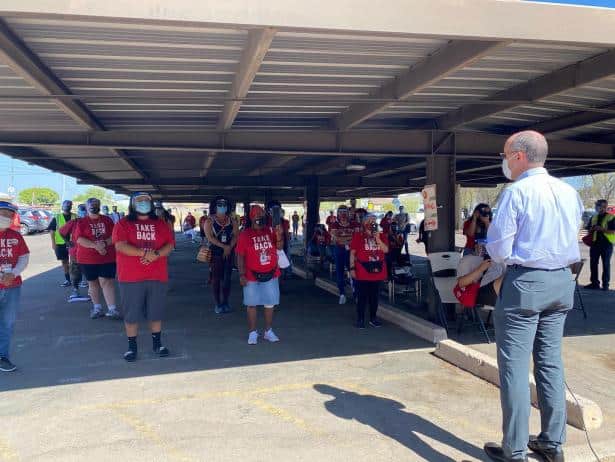
UNITE HERE Local 23 members who work at the Hilton in Houston have launched a nine-day strike, which started on Labor Day, demanding a $23 minimum wage, better safety measures, and improved working conditions. The walkout marks the union’s first hotel strike in Texas. Union President Franchesca Caraballo said the strike sends a clear message that “one job should be enough” in Houston. Despite ongoing negotiations, Hilton management has yet to meet union demands. The strike, involving over 400 workers, could impact operations at the nearby George R. Brown Convention Center, which is hosting major events during the strike period. Hilton said it respects workers’ rights and remains committed to good-faith negotiations. Workers plan to picket daily from 6 a.m. to 10 p.m. through September 10 and intend to return afterward but have not ruled out further action.
The Center for Labor & A Just Economy released a new report titled Workers at the Table: A Case Study of the Harris County Essential Workers Board. This report analyzes the Harris County Essential Workers Board (HCEWB). The HCEWB was stablished during the height of the COVID-19 pandemic and was created to ensure that policies affecting health, safety, and livelihoods are shaped by the lived experiences of workers themselves. It was formed through coordinated efforts among local and national allies, the HCEWB stands out among workforce standards boards by being entirely composed and led by essential workers—giving them a direct and meaningful voice in policymaking at the state and local levels. Learn more about the report and the HCEWB in an upcoming webinar.




Daily News & Commentary
Start your day with our roundup of the latest labor developments. See all
March 27
“Cesar Chavez Day” renamed “Farmworkers Day” in California after investigation finds Chavez engaged in rampant sexual abuse.
March 26
Supreme Court hears oral argument in an FAA case; NLRB rules that Cemex does not impose an enforceable deadline for requesting an election; DOL proposes raising wage standards for H-1B workers.
March 25
UPS rescinded its driver buyout program; California court dismissed a whistleblower retaliation suit against Meta; EEOC announced $15 million settlement to resolve vaccine-related religious discrimination case.
March 24
The WNBPA unanimously votes to ratify the league’s new CBA; NYU professors begin striking; and a district court judge denies the government’s motion to dismiss a case challenging the Trump administration’s mass revocation of international student visas.
March 23
MSPB finds immigration judges removal protections unconstitutional, ICE deployed to airports.
March 22
Resurgence in salting among young activists; Michigan nurses strike; states experiment with policies supporting workers experiencing menopause.