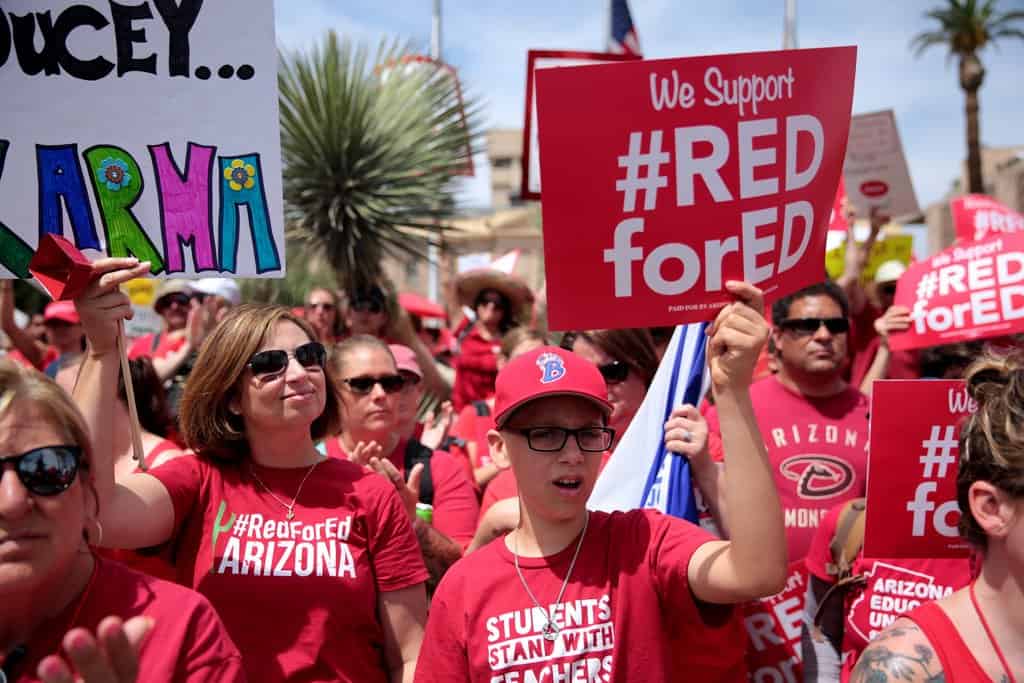

Teachers in Little Rock, Arkansas—home to one of the most important desegregation battles in American history—went on strike yesterday to protest a state plan that teachers say would resegregate the school system. Arkansas state took control of the school district in 2015, and recently used that power to strip Little Rock teachers of their collective bargaining rights. Although the state Board will return the district’s control to the local school board, the state will maintain some control over the district, including over schools the state decides need “intensive support.” Teachers say this would place schools that enroll high percentages of students of color in a different, state-controlled system. Little Rock teachers haven’t been on strike since 1987, but are joining a national wave of teachers strikes that swept the country last year. Last month, 30,000 Chicago Public Schools teachers went on an eleven-day strike to raise teacher pay and secure funding for school support staff like counselors and nurses.
The Trump Justice Department is digging its heels in on its position that so-called “no-poach” agreements are not per se illegal. No-poach agreements are agreements between businesses and franchisees not to hire workers from one another — making it harder for workers to move to a new business that offers better wages or benefits, or for workers who are facing wage theft or discriminatory harassment to find a new job. No-poach agreements, especially those in the fast food industry, have come under fire recently. After high-profile investigations by several state Attorneys General, seven major chains agreed to stop using the agreements last year, including McDonald’s, Arby’s, and Jimmy John’s. Workers’ and anti-trust advocates argue that no-poach agreements, like non-compete agreements, violate anti-trust law, keep wages low, and stifle job mobility. But Bloomberg reports that DOJ is continuing to defend these agreements in “private antitrust case filings, saying courts need to weigh their the pro-business justifications notably when it’s apart of a franchise arrangement.”
University of Chicago hospital nurses just voted to authorize a second strike on November 26, following a one-day strike and four-day lockout in September. As the Chicago Tribune reports, “it’s possible a strike could be averted if the hospital and the union representing the nurses, National Nurses Organizing Committee/National Nurses United, reach an agreement.” The nurses union objects to a new staffing plan proposed by management to eliminate patient care support nurses. In September, nearly 2,200 nurses walked out at three major Chicago hospitals.
In international strike news, South African Airways (SAA) was forced to cancel “nearly all” flights scheduled for today and tomorrow because employees are going on strike. Airline workers are joining a massive strike by public-sector workers protesting the airline’s plan to cut more than 900 jobs, according to Al Jazeera. The state-owned airline has struggled to turn a profit in recent years, but has continued operating thanks to several state bailouts.
Chicago’s Mayor Lightfoot just proposed raising the tipped minimum wage — but not to the cities’ $15 standard minimum wage.




Daily News & Commentary
Start your day with our roundup of the latest labor developments. See all
October 23
Employers increasingly shift health care costs onto workers and NYC proposes placing restrictions on fully automated customer service.
October 22
SCOTUS declines Wilcox appeal; Penn State research assistants win bargaining rights; SEIU sued over military leave firing.
October 21
DOL withdraws tipped-worker rule; Instacart settles hiring-bias claims; Phillips 66 locks out New Jersey refinery workers.
October 20
Korean unions oppose labor exemption bill; Portland city workers prepare for strike; UPenn grad student union looks to dismiss university filing
October 19
FDA reverses course on policy prohibiting off-duty union activity; FAA and NATCA reach deal to secure pay increase for air traffic controllers.
October 18
Federal judge again halts cancellation of the Bureau of Prisons’ CBA; tabletop gaming workers face roadblocks in union recognition.