
Swap Agrawal is a student at Harvard Law School.
In this weekend’s news and commentary, Shawn Fain won the runoff election for UAW president, and Michigan Gov. Gretchen Whitmer signed into law a repeal of right-to-work in the state.
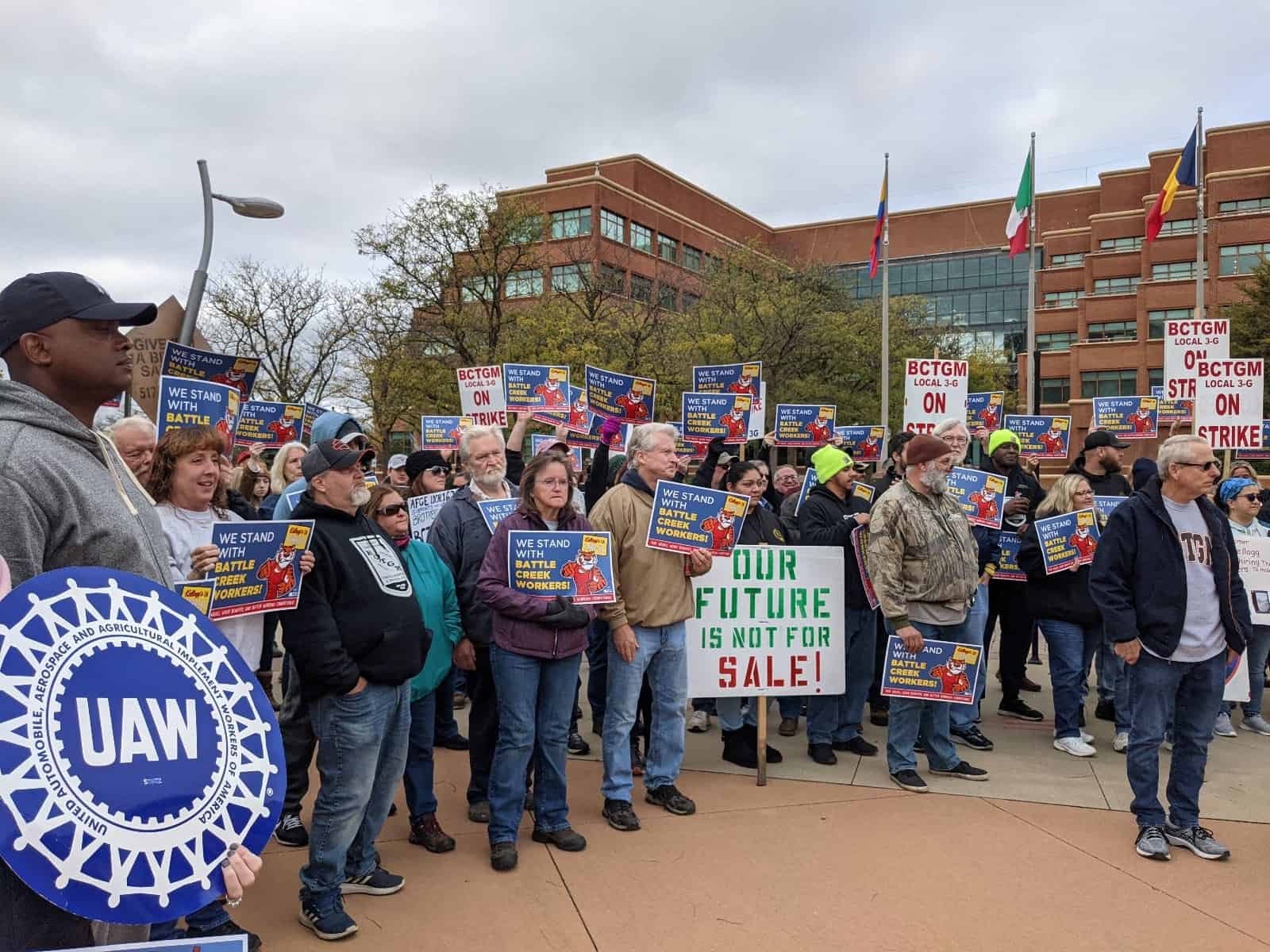
On March 25, Shawn Fain was announced the winner in a runoff election for United Auto Workers (UAW) president after narrowly defeating the incumbent head of the union, Ray Curry. Fain, a 54-year-old electrician, has been a UAW member for more than two decades and previously served as a local leader for a Stellantis parts plant in Indiana. Fain and other members of his leadership slate were part of the “UAW Members United” reform group which ran on the promise of “No corruption. No concessions. No tiers.” The last demand is a reference to the tiered pay system implemented by the automakers during recent negotiations.
Fain said in a statement after the win that the “election was not just a race between two candidates, it was a referendum on the direction of the UAW. For too long, the UAW has been controlled by leadership with a top-down, company union philosophy who have been unwilling to confront management, and as a result we’ve seen nothing but concessions, corruption, and plant closures.” Fain added that “while the election was close, it is clear that our membership has long wanted to see a more aggressive approach with our employers. We now have a historic opportunity to get back to setting the standard across all sectors.”
Fain’s election is part of UAW’s historic upheaval in leadership, as a majority of the union’ s International Executive Board will be made up of first-time directors who are not part of the “Administration Caucus” that has controlled the union for more than 70 years. More than 141,500 ballots were cast in the runoff which constitutes a 33% increase from last year’s direct election. The shakeup in the union’s leadership comes at a critical time, as UAW’s collective bargaining contracts with Detroit’s Big Three automakers expire in September. Fain was sworn in on March 26, one day ahead of the launch of the union’s bargaining convention.
On March 24, Michigan Governor Gretchen Whitmer signed legislation repealing a 2012 law which workers to choose not to pay union dues or join the union as a condition of their employment, even if the union represented them in negotiations as it is legally required to do. “Michigan workers are the most talented and hard-working in the world and deserve to be treated with dignity and respect,” said Whitmer in a statement. State Senator Darrin Camilleri, the sponsor of the bill, added that “[t]oday is a historic win for workers everywhere, and this is the first time any state has been able to do this in almost sixty years. … this is tangible proof that the Republican attack on organized labor has failed.” The Governor also signed HB 4007 which restores prevailing wage standards on all state projects. As Jacqueline reported a few weeks ago, the Michigan legislature passed the repeal of right-to-work after Democrats took control of Michigan’s House and Senate for the first time in 40 years. Gov. Whitmer had promised to sign the bill once both chambers agreed on the final version and sent it to her desk.


Daily News & Commentary
Start your day with our roundup of the latest labor developments. See all
October 19
FDA reverses course on policy prohibiting off-duty union activity; FAA and NATCA reach deal to secure pay increase for air traffic controllers.
October 18
Federal judge again halts cancellation of the Bureau of Prisons’ CBA; tabletop gaming workers face roadblocks in union recognition.
October 16
Department of Labor reduces wage-and-hour enforcement at unionized workplaces; Fain's victory poses question of federal monitor's extension.
October 15
New reporting examines the rollback of child labor protections; California tries to block a strike; NLRB charges Wisconsin mental health provider with firing workers during union drive.
October 14
Eleventh Circuit overturns ERISA exhaustion rule; DHS finalizes removal of automatic renewal for work permits; AFGE challenges SSA over flexible scheduling policy.
October 13
Chicago hotel workers remain on strike; a coalition of Democratic states sues the Labor Department over canceled unemployment insurance grants; the Federal Labor Relations Authority establishes a new mediation framework for federal worker disputes.