
Everest Fang is a student at Harvard Law School.
In today’s news and commentary: major unions demand an end to military aid for Israel, Teamsters and UAW withhold endorsements of Kamala Harris, and Pennsylvania judge declines to block FTC non-compete ban.
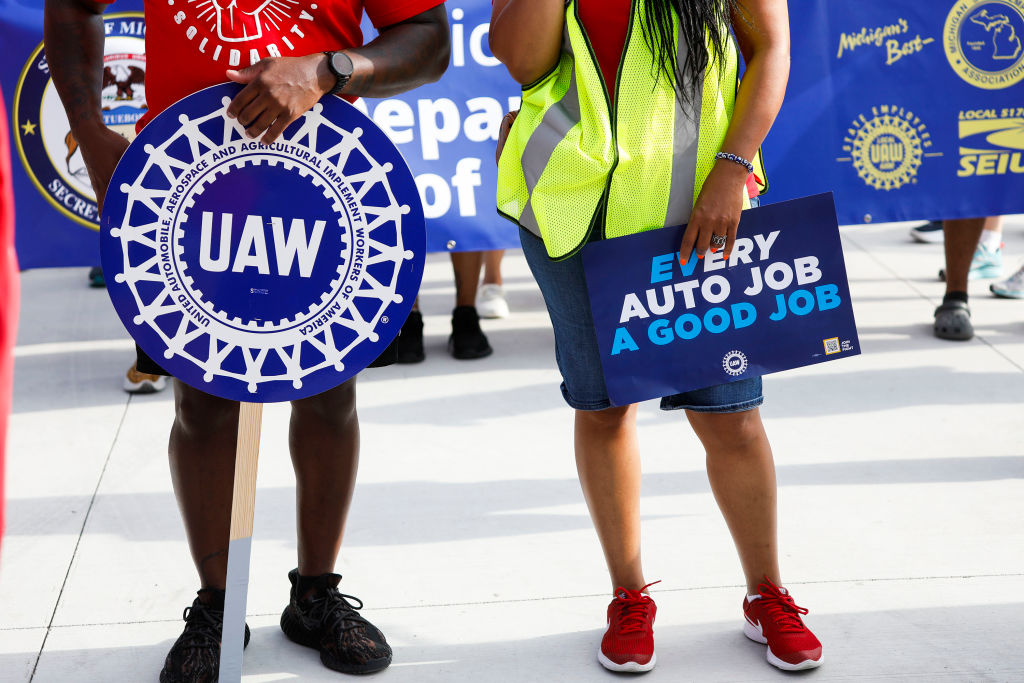
Yesterday, a group of major labor unions sent a letter to the White House demanding that the United States stop sending military aid to Israel. The letter asserts that “immediately cutting US military aid to the Israeli government is necessary to bring about a peaceful resolution” to the conflict. The letter’s signatories include the American Postal Workers Union, Association of Flight Attendants, the International Union of Painters and Allied Trades, the National Education Association, Service Employees International Union, United Auto Workers and United Electrical Workers. In a press release, Mark Dimondstein, president of the postal workers’ union, said that the “unions are hearing the cries of humanity as this vicious war continues.” He continued: “Working people and our unions are horrified that our tax dollars are financing this ongoing tragedy. We need a cease-fire now, and the best way to secure that is to shut off U.S. military aid to Israel.” The letter comes as Israeli Prime Minister Benjamin Netanyahu begins his visit to Washington this week.
As Otto wrote on Monday, Vice President Kamala Harris has received endorsements from many of the nation’s largest labor unions since she announced her candidacy for president. A few powerful unions, however, have so far withheld their endorsements. Notably, the International Brotherhood of Teamsters and United Auto Workers (UAW) – two unions with big presences in swing states – have yet to back Harris. Last week, Teamsters President Sean O’Brien broke from tradition to speak at the Republican National Convention in Milwaukee. As John wrote, some are speculating that the Teamsters may not endorse any candidate. Meanwhile, Shawn Fain, president of UAW, has sent mixed signals since Biden withdrew from the race. On Monday, Fain said that his union was going to take its time before formally endorsing another candidate. In an interview on MSNBC, Fain mentioned that the union was looking at Harris’s potential vice presidential candidates, among other considerations.
Yesterday, a federal judge in Pennsylvania declined to block the FTC’s ban on noncompete agreements. The decision preserved the FTC’s new rule, which is set to take effect on September 4. ATS Tree Services, a tree-removal company, challenged the rule in the U.S. District Court for the Eastern District of Pennsylvania. Judge Kelley Brisbon Hodge ruled that ATS had not proved that it would suffer irreparable harm from the rule. Denying the company’s motion for a preliminary injunction, she said the lawsuit was unlikely to prevail on the merits. The Pacific Legal Foundation, the libertarian law group representing ATS, vowed to “continue to fight the FTC’s power grab,” but declined to say whether they would appeal. Regardless, employers remain in limbo as they await a decision from Judge Ada Brown of the U.S. District Court for the Northern District of Texas, who this month granted a preliminary injunction preventing application of the rule to the plaintiffs in that case. Judge Brown also said that the FTC lacked “substantive rule-making authority” with respect to unfair methods of competition and that the plaintiffs were “likely to succeed on the merits” of their challenge. She is expected to issue a final decision by the end of August.


Daily News & Commentary
Start your day with our roundup of the latest labor developments. See all
October 19
FDA reverses course on policy prohibiting off-duty union activity; FAA and NATCA reach deal to secure pay increase for air traffic controllers.
October 18
Federal judge again halts cancellation of the Bureau of Prisons’ CBA; tabletop gaming workers face roadblocks in union recognition.
October 16
Department of Labor reduces wage-and-hour enforcement at unionized workplaces; Fain's victory poses question of federal monitor's extension.
October 15
New reporting examines the rollback of child labor protections; California tries to block a strike; NLRB charges Wisconsin mental health provider with firing workers during union drive.
October 14
Eleventh Circuit overturns ERISA exhaustion rule; DHS finalizes removal of automatic renewal for work permits; AFGE challenges SSA over flexible scheduling policy.
October 13
Chicago hotel workers remain on strike; a coalition of Democratic states sues the Labor Department over canceled unemployment insurance grants; the Federal Labor Relations Authority establishes a new mediation framework for federal worker disputes.