John Fry is a student at Harvard Law School.
In today’s news and commentary, Starbucks limits mobile ordering after unions fight understaffing; UAW eyes non-union automakers; and House Democrats call for investigation of Los Angeles hotels.
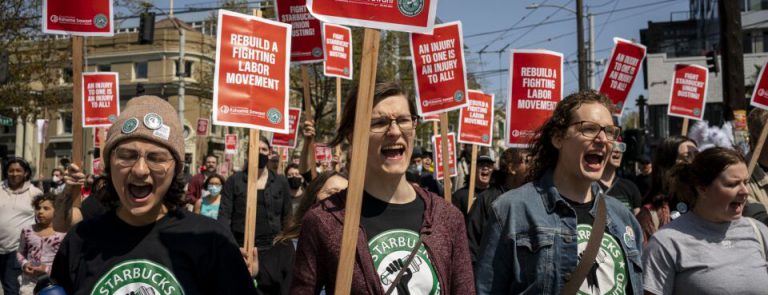
Weeks after Starbucks Workers United held rallies and strikes to protest understaffing, the company has announced it will allow overwhelmed stores to pause mobile drink ordering starting next month, Bloomberg reports. SWU events across the country brought attention to the issue on Starbucks’ annual “Red Cup Day” last month. While the company claims the change is unrelated to the union’s understaffing activism, internal documents do cite “employee absences” as a reason for introducing the feature. In a statement, SWU declared that “strikes work” and vowed to keep up the pressure until it collectively bargains a first contract.
After winning a new contract at the nation’s “Big Three” automakers, the United Auto Workers has announced a plan to organize workers at 13 non-union automakers, including Tesla and Toyota. Non-union automakers have been hiking wages since the UAW agreements were announced. UAW president Shawn Fain has said that by the time the union’s Big Three contracts expire in May 2028, UAW will be bargaining with “the Big Five or Big Six.” Fain has publicly urged other unions to bargain contracts with the same May 2028 expiration date to maximize union solidarity and labor’s disruptive capacity across the economy.
House Democrats from California have urged the Department of Labor to investigate reports that Los Angeles hotels are exploiting migrant workers as strike-breakers. UNITE HERE Local 11 has been striking dozens of hotels in Los Angeles since June and has reached agreements with five so far. As I reported in October, the hotels are accused of hiring migrants (including minors) without telling them their wages or the identity of their employers. The City of Los Angeles is also investigating the allegations.

Daily News & Commentary
Start your day with our roundup of the latest labor developments. See all
September 22
Judge blocks ICE raids in Alabama; Chicago hotel workers vote to strike; AutoZone workers look to create first union
September 21
In today’s News and Commentary, the Seventh Circuit raises the bar for the NLRB to obtain preliminary injunctions, the California Primary Care Association sues SEIU-UHW for racketeering, and the Seventh Circuit finds that an employer group and think tank do not have standing to challenge an Illinois law banning captive audience meetings. On Friday, the […]
September 20
Culinary Workers Union members protests union leadership; lawsuit against OpenAI and Microsoft reveal internal concerns about the threat of AI training to human labor.
September 17
Unions push to block Google from buying Spirit Airlines employment records; U.S. Department of Labor sues Oklahoma coffee chain over alleged wage violations.
September 16
Trump nominates Catherine Eschbach as EEOC general counsel; NLRB declines to resolve union work-assignment dispute; Allina Health physicians begin four-day strike.
September 15
Documents reveal the inner workings of Amazon's union avoidance program; Washington state public sector unions reach tentative deals amid a difficult bargaining cycle; hundreds of Nevada Culinary Union members protest their union's health care changes.