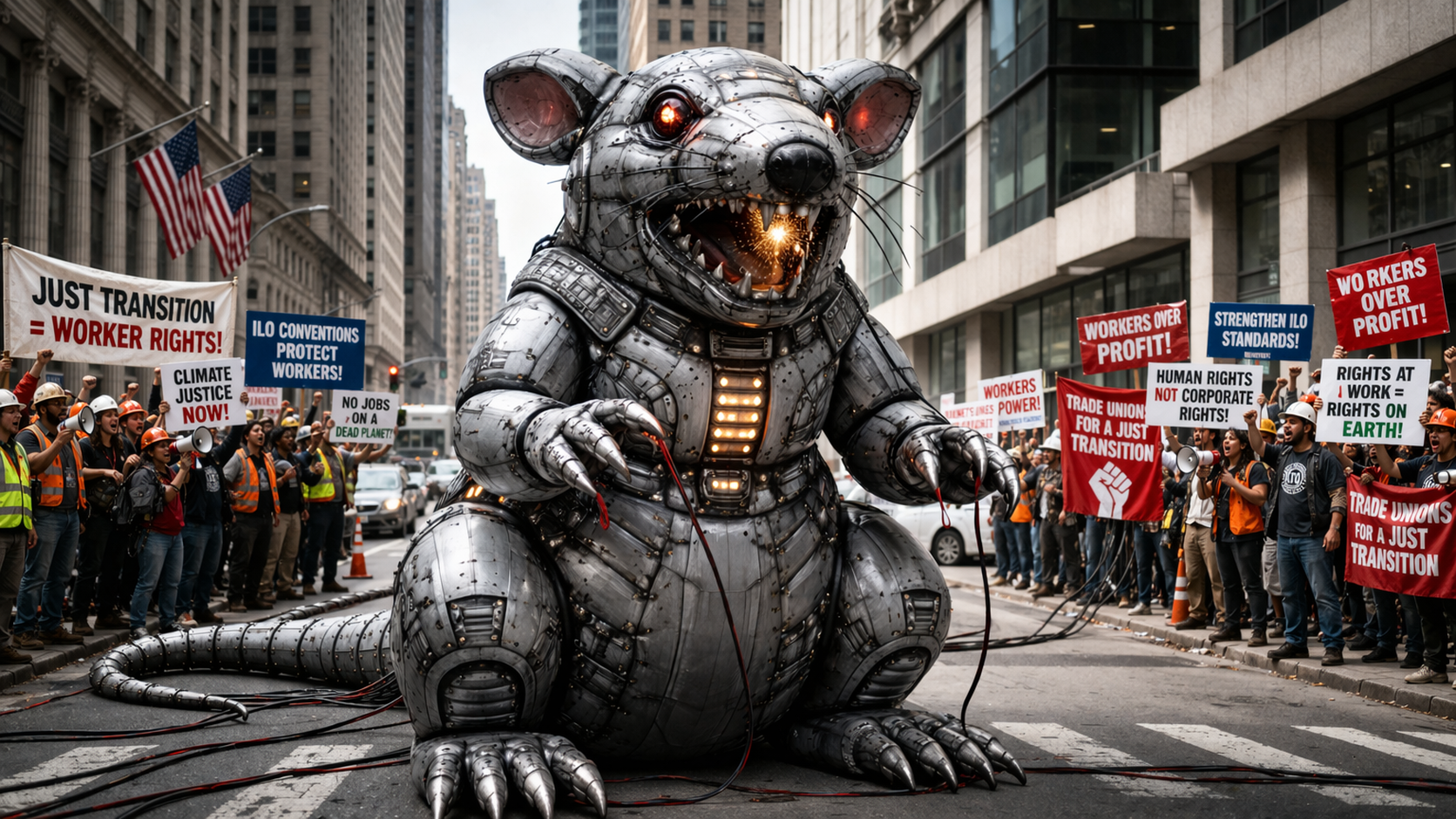

Jeffrey Vogt is the Rule of Law Director of the Solidarity Center and Co-Founder and Chair of the ILAW Network.
Ruwan Subasinghe is the Legal Director of the International Transport Workers Federation (ITF).
When journalists at The Guardian went on strike over their employer’s attempts to sell the business in late 2024, they were probably not expecting to be among the first victims of strike-breaking by artificial intelligence. Over the course of the strike, members of the National Union of Journalists (NUJ) were flummoxed by the venerable paper’s “weird” headlines that “appeared to be the sort of thing that you would see in a TV drama when they try to mock up a newspaper.” Soon they realized that their bosses had used artificial intelligence to generate the headlines. All of this was done during a lawful strike without consulting the union on AI deployment in the workplace, let alone on AI deployment during a strike.
The incident at The Guardian was not a one-off. Just weeks before, striking New York Times Tech Guild members learned via X that the CEO of Perplexity, Aravind Srinivas, had effectively offered the NYT’s publisher his AI services to help defeat the labor action. While Srinivas later clarified that his offer was “not to ‘replace’ journalists or engineers with AI but to provide technical infra support on a high-traffic day,” it did not offer much comfort as the striking workers were in fact the ones doing the very job he was proposing to provide “technical” support for.
With the labor impacts of AI dominating headlines around the world, what is clear is that effective regulation is sorely lagging behind, putting the right to exercise one’s freedom of association, including to strike, even further at risk. If predictions of an AI “tsunami hitting the labour market”, with young people worst affected, are to be believed, the right to strike will inevitably be an indispensable tool to both protect jobs and ensure that any productivity gains attributable to AI are shared equitably with workers. For this reason, it is critical to ensure that there is no doubt as to the prohibition on the use of AI, in addition to humans, to replace striking workers. Building on Ben Gantt’s excellent proposed framework to resolve this legal ambiguity at the domestic level in the United States, we consider the position under international labor law.
In the minority of jurisdictions that allow for the use of replacement workers during economic strikes, such as the United States, employers will no doubt use human and AI replacement labor to apply economic pressure to undermine the effectiveness of industrial action. While an employer can refuse to reinstate strikers upon their unconditional offer to return to work where replacement human labor has been hired, it is unclear how courts would find if the replacement labor were not human but a bot.
International labor law may provide the answer. The International Labour Organization’s (ILO) tripartite Committee on Freedom of Association (CFA) has for over 70 years defined the scope of the right to freedom of association, including the right to strike. It has consistently held that the hiring of workers to break a strike in a sector which cannot be regarded as an essential sector in the strict sense of the term, and hence one in which strikes might be forbidden, constitutes a serious violation of freedom of association. Indeed, the CFA holds that strikers could be replaced only: (a) in the case of a strike in an essential service in the strict sense of the term in which the legislation prohibits strikes; and (b) where the strike would cause an acute national crisis. The CFA has also unequivocally stated that recourse to the use of labor drawn from outside the undertaking to replace the strikers for an indeterminate period entails a risk of derogation from the right to strike.
While the CFA (or any other ILO supervisory body) has not yet had occasion to consider a situation where artificial intelligence has been used in an attempt to break a strike, it should find such a practice to be a serious violation of freedom of association. The CFA is unambiguous on the question of the ‘replacement’ of striking workers. Of course, the assumption has been replacement of striking workers by other human workers, but there seems no reason to so limit our understanding of this principle. What the ILO is of course guarding against is the replacement of the work being done with a view to diminishing the impact of the strike by permitting the enterprise to continue operating as before. It should make no difference how the labor is being replaced, whether by AI tools developed in-house or purchased from outside. Moreover, AI is created and operated by human labor, so the argument that AI which is executing human instructions to human aims is not effectively a replacement worker is not credible. While taking no position on the actual intelligence or consciousness of AI, clearly these bots are widely viewed as substituting for human labor.
The permanent introduction of AI during the course of a strike, even if is seen as tantamount to the introduction of labor-saving machinery of an earlier age, if done for the purpose of retaliating against striking workers, would appear to be prohibited as an act of anti-union retaliation under ILO Convention 98 on the Right to Organize and Collective Bargaining as well. Essentially, automation as a retaliatory instrument can only be viewed as dismissal of workers on account of their having participated in a strike, a practice which the CFA has long-held to constitute serious discrimination in employment on grounds of legitimate trade union activities. As such, under international labor law, any form of (permanent) capital substitution directly in response to a strike cannot be justified as an employer exercising their prerogative to automate. Further, if there is a pre-existing collective agreement that is still in force, it is also quite likely a violation of the terms and conditions of that agreement to introduce AI without negotiation with the union. Nevertheless, it will be important for the CFA to clarify its position in a relevant future case and for the Committee of Experts on the Application of Conventions and Recommendations to do the same in its next General Survey on fundamental conventions.
Therefore, with AI strikebreaking and AI-driven union-busting programs already in use, the need to protect the right to strike in the age of machine learning has become urgent. While the ILO supervisory bodies could help reiterate, clarify and expand on current protections, regional and national legislatures should act now. The recent vote in the European Parliament in favor of EU action on digitalization, artificial intelligence and algorithmic management at work is a welcome move in the right direction.
Jack London famously stated that scabs are capital’s most formidable weapon. AI strikebreaking has only made this management tool that much more powerful. There is simply no time to waste in stopping AI from further undermining a fundamental labor right.





Daily News & Commentary
Start your day with our roundup of the latest labor developments. See all
October 16
Department of Labor reduces wage-and-hour enforcement at unionized workplaces; Fain's victory poses question of federal monitor's extension.
October 15
New reporting examines the rollback of child labor protections; California tries to block a strike; NLRB charges Wisconsin mental health provider with firing workers during union drive.
October 14
Eleventh Circuit overturns ERISA exhaustion rule; DHS finalizes removal of automatic renewal for work permits; AFGE challenges SSA over flexible scheduling policy.
October 13
Chicago hotel workers remain on strike; a coalition of Democratic states sues the Labor Department over canceled unemployment insurance grants; the Federal Labor Relations Authority establishes a new mediation framework for federal worker disputes.
October 12
Workers at the Obama Foundation begin organizing; MLB submits its latest collective bargaining agreement proposal; Brigham & Women's nurses postpone strike.
October 11
UAW President Shawn Fain succeeds in his reelection bid, and Spanish unions call for a general strike.