
Will Ebeler is a student at Harvard Law School.
In this weekend’s news and commentary, workers get wins in two fights against forced arbitration; In-N-Out Burger bans masks for employees in five states; and new data shows impact of Hollywood strikes on the movie and television industry.
Last week, two federal courts of appeals issued decisions in favor of workers who are trying to avoid arbitrating their claims. First, on Thursday the Sixth Circuit ruled that Papa Johns could not enforce an arbitration agreement against a worker who claimed he never saw it. Andrew Bazemore sued Papa Johns on behalf of delivery drivers in Kentucky for allegedly violating federal wage and hour law. According to Bazemore, the company reimbursed him for driving costs at roughly half the recommended rate, and as a result his wages were lower than both federal and state minimum wage. The company argued that Bazemore had signed an agreement to arbitrate disputes, but the court on Thursday held that there was no reason to prevent a jury from believing Bazemore’s claim that he never saw that agreement.
Then on Friday, the Ninth Circuit held that semitruck drivers for Domino’s Pizza could pursue a wage and hour class action, rather than being forced into arbitration. The drivers deliver products from supply centers to franchisee storefronts, and they are suing Domino’s for unpaid wages and insufficient reimbursements for expenses they incur on the job. As the Ninth Circuit explained, the Federal Arbitration Act generally favors mandatory arbitration agreements. However, there is an exception for interstate transportation workers, and in 2020, the court held in Rittman v. Amazon, Inc. that “last mile” drivers for Amazon who were responsible only for the last leg of the delivery process fall under that exception. The court explained here that Domino’s delivery drivers are analogous to Amazon’s last mile drivers and qualify for the exception: “Because the goods in this case were inevitably destined from the outset of the interstate journey for Domino’s franchisees, it matters not that they briefly paused that journey at the supply center.” This is the second time the Ninth Circuit has found that these plaintiffs qualify for an exception to the Federal Arbitration Act, having reached the same result in 2021. But in 2022, the Supreme Court in Southwest Airlines v. Saxon held that a cargo loader for Southwest Airlines qualified for the interstate commerce exemption, and the Court remanded the Domino’s case to the Ninth Circuit to reconsider the case in light of Saxon. In Friday’s opinion, the Ninth Circuit explained that because Saxon and Rittman were not clearly in conflict, it was bound to follow its own precedent in Rittman. Although Domino’s did not say it would appeal the decision to the Supreme Court, the attorney for the plaintiffs said he expected it to file an appeal.
Next, in August In-N-Out Burger will begin banning workers in five states from wearing masks. Employees in Arizona, Colorado, Nevada, Texas and Utah will face disciplinary action “up to and including termination” if they wear masks in violation of the policy. The company will have an exception for employees with specific medical conditions that require them to wear masks; those employees will have to provide a “valid medical note.” Employees in Oregon and Nevada can continue wearing store-provided N-95 masks. The separate guidelines for those states are likely based on differences in state laws: California state law requires employers to let their employees wear masks.
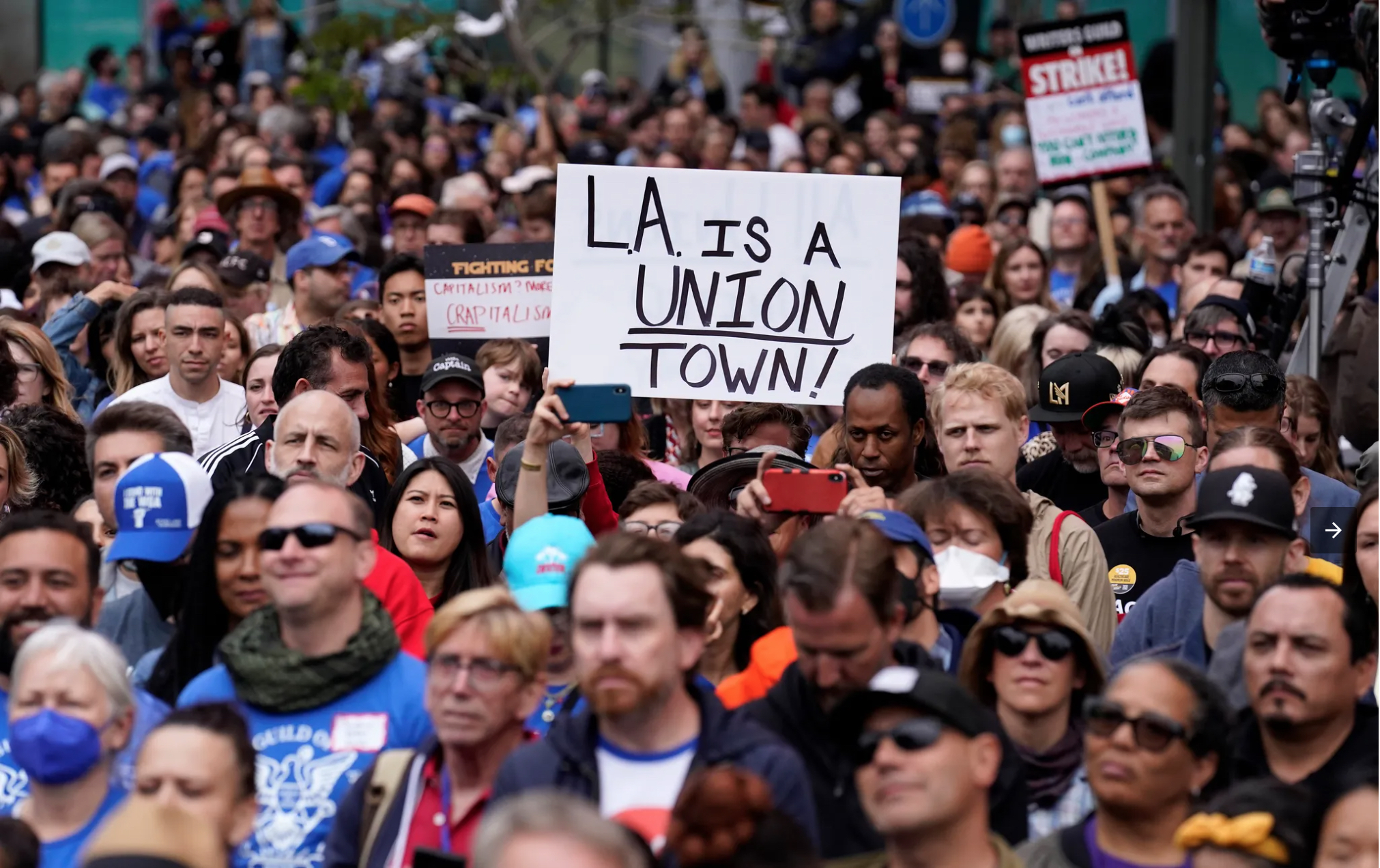
Finally, new data from the second quarter of the year shows the impact the writers’ strike has had on Hollywood. Movie and television production in Los Angeles has plummeted, and the second quarter of the year saw a 28% drop in “shoot days” from the same period last year. According to the Times, a “shoot day” is defined as one crew getting permission to film at least one location during a single 24-hour period, and the number of of shoot days measures the amount of production in the region. Television was hit hardest, with a 36% fall in shoot days, and TV dramas and comedies each had over 60% fewer shoot days than the same period last year. The second-quarter data did not capture the effect of the actors’ strike, which began after the second quarter ended.





Daily News & Commentary
Start your day with our roundup of the latest labor developments. See all
October 20
Korean unions oppose labor exemption bill; Portland city workers prepare for strike; UPenn grad student union looks to dismiss university filing
October 19
FDA reverses course on policy prohibiting off-duty union activity; FAA and NATCA reach deal to secure pay increase for air traffic controllers.
October 18
Federal judge again halts cancellation of the Bureau of Prisons’ CBA; tabletop gaming workers face roadblocks in union recognition.
October 16
Department of Labor reduces wage-and-hour enforcement at unionized workplaces; Fain's victory poses question of federal monitor's extension.
October 15
New reporting examines the rollback of child labor protections; California tries to block a strike; NLRB charges Wisconsin mental health provider with firing workers during union drive.
October 14
Eleventh Circuit overturns ERISA exhaustion rule; DHS finalizes removal of automatic renewal for work permits; AFGE challenges SSA over flexible scheduling policy.