

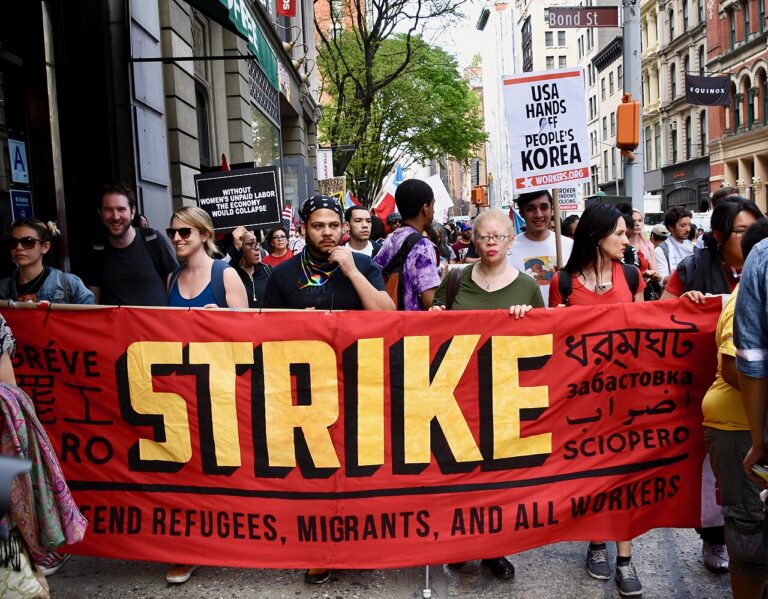
Hundreds of thousands of people gathered this weekend for ‘March For Our Lives’ protests across the country and around the world. The student-lead movement for gun control has not weakened in the weeks since the Parkland, Florida shooting. Read more about the March here. Watch a few of the moving speeches for March for Our Lives in D.C. here.
On Friday, President Trump announced that he would adopt Defense Secretary Jim Mattis’s recommendations regarding transgender troops. “Transgender troops who are currently in the United States military may remain in the ranks, the White House said late Friday, but the Pentagon could require them to serve according to their gender at birth.” The policy recommendation comes after a court ruling stayed President Trump’s initial ban on transgender individuals serving in the military last July. Then, in October a Judge rejected the Trump Administration’s assertion that it needed more time to “prepare to process transgender recruits for military service. ‘The court is not persuaded that defendants will be irreparably injured by allowing the accession of transgender individuals into the military beginning on Jan. 1, 2018,’ she wrote.” Advocates quickly announced that they would fight the new policy recommendation, which still must be published in the federal register.
Also on Friday, President Trump “reluctantly” signed the $1.3 trillion spending bill that saw domestic spending increase so that Trump could get the military spending he wanted. The bill did not address any new gun control measures or provide a remedy for DACA recipients.
Over the weekend, Harvard Law Climenko Fellow and ‘First Mondays’ podcast host Ian Samuel tweeted that big law firm Munger, Tolles & Olson was requiring “summer associates to agree to submit any claims of (among other things) workplace harassment to secret arbitration by an arbitrator of the firm’s selection.” Samuel has received a copy of the arbitration agreement and posted a number of sections to Twitter, including a provision that made mandatory arbitration and a secrecy clause applicable to Title VII claims. The response from the legal community was swift and fierce, prompting MTO to tweet on Sunday that it would “no longer require any employees, including summer associates, to sign any mandatory arbitration agreements.” While a victory, there is still an understanding that MTO is not the only firm to have required this kind of contract, and that the contract’s existence further supports the need for a #metoo reckoning in the legal profession.
A New Orleans Saints’ cheerleader filed a complaint with the Equal Employment Opportunity Commission, accusing “the Saints of having two sets of rules — one for the team’s cheerleaders, who are all women, and another for its players” in violation of the N.F.L.’s discrimination policy. The complaint asserts that Cheerleaders are under strict rules to have no contact with players, that the players are not forced to adhere as well. “Cheerleaders are told not to dine in the same restaurant as players, or speak to them in any detail. If a Saints cheerleader enters a restaurant and a player is already there, she must leave. If a cheerleader is in a restaurant and a player arrives afterward, she must leave.”



Daily News & Commentary
Start your day with our roundup of the latest labor developments. See all
January 29
Texas pauses H-1B hiring; NLRB General Counsel announces new procedures and priorities; Fourth Circuit rejects a teacher's challenge to pronoun policies.
January 28
Over 15,000 New York City nurses continue to strike with support from Mayor Mamdani; a judge grants a preliminary injunction that prevents DHS from ending family reunification parole programs for thousands of family members of U.S. citizens and green-card holders; and decisions in SDNY address whether employees may receive accommodations for telework due to potential exposure to COVID-19 when essential functions cannot be completed at home.
January 27
NYC's new delivery-app tipping law takes effect; 31,000 Kaiser Permanente nurses and healthcare workers go on strike; the NJ Appellate Division revives Atlantic City casino workers’ lawsuit challenging the state’s casino smoking exemption.
January 26
Unions mourn Alex Pretti, EEOC concentrates power, courts decide reach of EFAA.
January 25
Uber and Lyft face class actions against “women preference” matching, Virginia home healthcare workers push for a collective bargaining bill, and the NLRB launches a new intake protocol.
January 22
Hyundai’s labor union warns against the introduction of humanoid robots; Oregon and California trades unions take different paths to advocate for union jobs.