

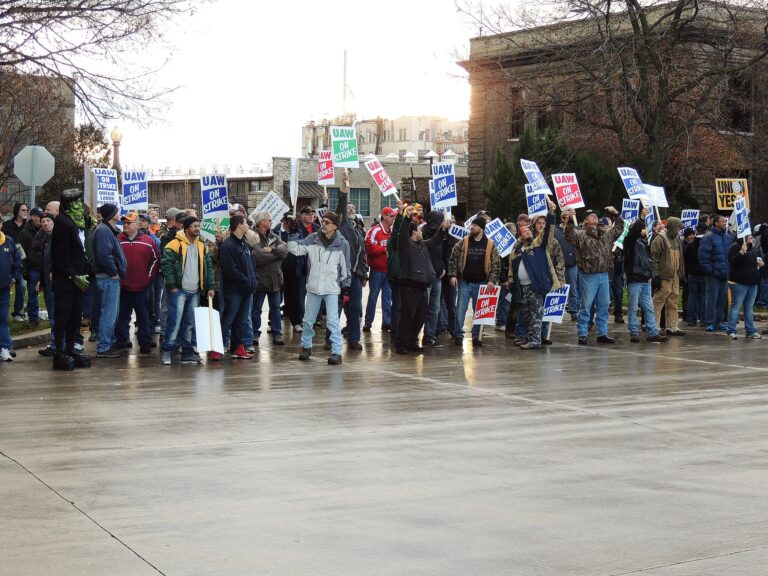
Allegheny Technologies (ATI) will fight the complaint that the National Labor Relations Board (NLRB) has filed over the lockout of 2,200 members of the United Steelworkers (USW) union. According to the Pittsburgh Post-Gazette, the lockout—which began on August 15, 2015 and affects workers at twelve plants across six states—resulted after the specialty metals producer and USW failed to renegotiate a contract that expired on June 30 of last year. The NLRB announced in December that the ATI’s lockout constituted an unfair labor practice and has scheduled a hearing for May 23 in Pittsburgh.
The Department of Labor announced a decrease in the number of Americans filing for first-time state unemployment benefits last week, reports the Wall Street Journal and Reuters. Initial unemployment benefits, which serves as a proxy for layoffs across the country, declined by 16,000 to a seasonally adjusted total of 269,000 for the week ended February 6. This figure is the lowest it has been since last December. Correspondingly, the number of continuing unemployment benefit claims also fell by 21,000 in the week ended January 30.
Donald Trump’s assertion that the real unemployment rate could be as high as 42 percent “might be bombastic, but . . . not entirely wrong,” according to Neil Irwin of the New York Times. Irwin explained that there are “infinite” ways to calculate the unemployment rate and that the Bureau of Labor Statistics itself reports six different joblessness figures, even though one of the six (the U-3) is the most frequently cited. Because only 59.6 percent of the U.S. population was employed in January, 40.4 percent could be considered not employed, to make sense of Trump’s math. This figure, however, would take into account retirees, college students, and voluntary stay-at-home parents as unemployed. Irwin quipped that including not only those over the age of 16 but also all children in the country in the calculation could yield “a jobless rate of about 53 percent!”
Southwest Airlines announced a record employee profit-share of $620 million for 2015. This figure translates to about eight weeks of pay, or 15.6 percent of total annual compensation, for every eligible employee. The Dallas Morning News reports that the profit-share amount will be funded on April 29 and will bring Southwest’s cumulative profit share to $1.4 billion over the last five years.




Daily News & Commentary
Start your day with our roundup of the latest labor developments. See all
March 20
Appeal to 9th Cir. over law allowing suit for impersonating union reps; Mass. judge denies motion to arbitrate drivers' claims; furloughed workers return to factory building MBTA trains.
March 19
WNBA and WNBPA reach verbal tentative agreement, United Teachers Los Angeles announce April 14 strike date, and the California Gig Workers Union file complaint against Waymo.
March 18
Meatpacking workers go on strike; SCOTUS grants cert on TPS cases; updates on litigation over DOL in-house agency adjudication
March 17
West Virginia passes a bill for gig drivers, the Tenth Circuit rejects an engineer's claims of race and age bias, and a discussion on the spread of judicial curtailment of NLRB authority.
March 16
Starbucks' union negotiations are resurrected; jobs data is released.
March 15
A U.S. District Court issues a preliminary injunction against the Department of Veterans Affairs for terminating its collective bargaining agreement, and SEIU files a lawsuit against DHS for effectively terminating immigrant workers at Boston Logan International Airport.