
Jacqueline Rayfield is a student at Harvard Law School.
In today’s News and Commentary, the Amazon Labor Union agrees to affiliate with the Teamsters union, organizers consider partnerships with tenant organizations and expanding political power for workers.
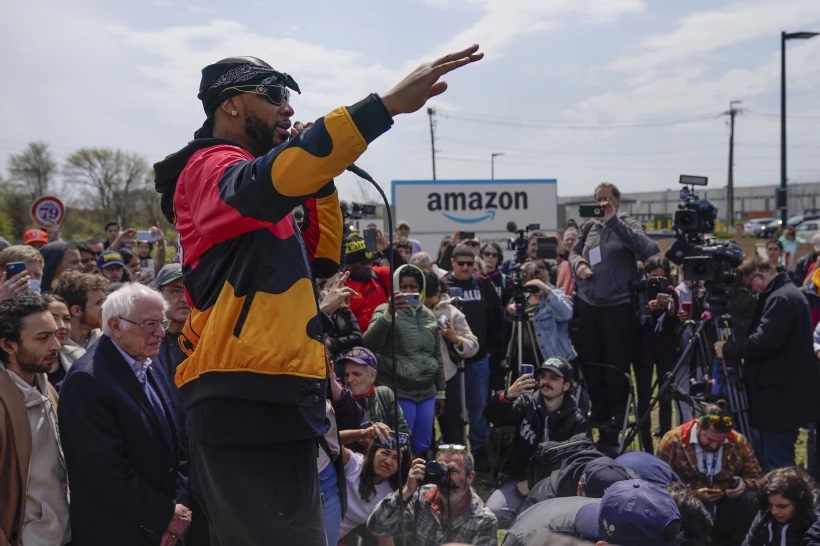
Teamsters President Sean M. O’Brien announced that Amazon workers would consider affiliating with the national union in a meeting no Tuesday. Amazon Labor Union members still must vote to ratify the decision, while Teamsters’ board has already unanimously approved the move. Voting members of Amazon Labor Union include workers at one warehouse location in Staten Island who won a landmark labor victory by organizing their workplace two years ago. Since being certified as a union, has faced growing pains in establishing an organizing strategy and lost two elections at other Amazon warehouses. Amazon Labor Union President Chris Smalls wrote of the new affiliation that his workplace would be joining “with one of the most powerful unions to take on Amazon together.”
Mary Kay Henry, former president of the Service Employees International Union (SEIU) explains to The Atlantic how unions can expand their influence despite low union density. Despite only 11 percent union density in the U.S., support for unions has surged in recent years. Henry believes that this support can be harnessed to build worker power despite the low percentage of Americans who belong to a union. SEIU’s participation in the historic Fight for $15, which advocated for a $15 minimum wage across the country demonstrated how unions can influence working conditions outside of their membership. The Fight won important victories as Seattle and other cities raised their minimum wage for all workers, not just SEIU members. This same strategy could be used to harness union support outside of their ranks, according to Henry.
Jacobin staff writers consider partnerships between unions and tenant organizations an important step in building working class power. The Chicago Teachers Union included a bargaining proposal for affordable housing, Tacoma, Washington food and commercial workers canvassed for an eviction moratorium, and unions in San Francisco and Minnesota pushed for rent-control. These partnerships demonstrate how labor and housing advocates can successfully join forces.





Daily News & Commentary
Start your day with our roundup of the latest labor developments. See all
October 21
DOL withdraws tipped-worker rule; Instacart settles hiring-bias claims; Phillips 66 locks out New Jersey refinery workers.
October 20
Korean unions oppose labor exemption bill; Portland city workers prepare for strike; UPenn grad student union looks to dismiss university filing
October 19
FDA reverses course on policy prohibiting off-duty union activity; FAA and NATCA reach deal to secure pay increase for air traffic controllers.
October 18
Federal judge again halts cancellation of the Bureau of Prisons’ CBA; tabletop gaming workers face roadblocks in union recognition.
October 16
Department of Labor reduces wage-and-hour enforcement at unionized workplaces; Fain's victory poses question of federal monitor's extension.
October 15
New reporting examines the rollback of child labor protections; California tries to block a strike; NLRB charges Wisconsin mental health provider with firing workers during union drive.